The Question on the Table

 EDO SEGAL: Somewhere in the world right now — in the time it takes me to say this sentence — a machine is learning to do something no one taught it. Not being told. Not being programmed. Learning, the way water learns the shape of a slope: by running down it and finding out. A model somewhere is adjusting a billion numbers a fraction of a degree because its last guess was a little wrong, and its next guess will be a little less wrong, and nobody in the building can point to the place where the knowing lives. It is three in the morning in some data center and the lights are off and the thing is getting smarter in the dark.

And the question I have brought two of the best minds who ever lived to this table to fight about is the oldest question under that fact, and the newest. When you arrive at the floor where the machine starts to know — really know, not merely do — how does it get there? Do you climb to knowing by engineering reason in, brick by clean brick, the way you build a cathedral? Or do you climb by getting out of the way and letting it learn, the way you let a child learn to walk by letting go of the hand? Is knowing something you compose — or something you converge on?
I have wanted this conversation for most of my life. I had to bend time to get it.

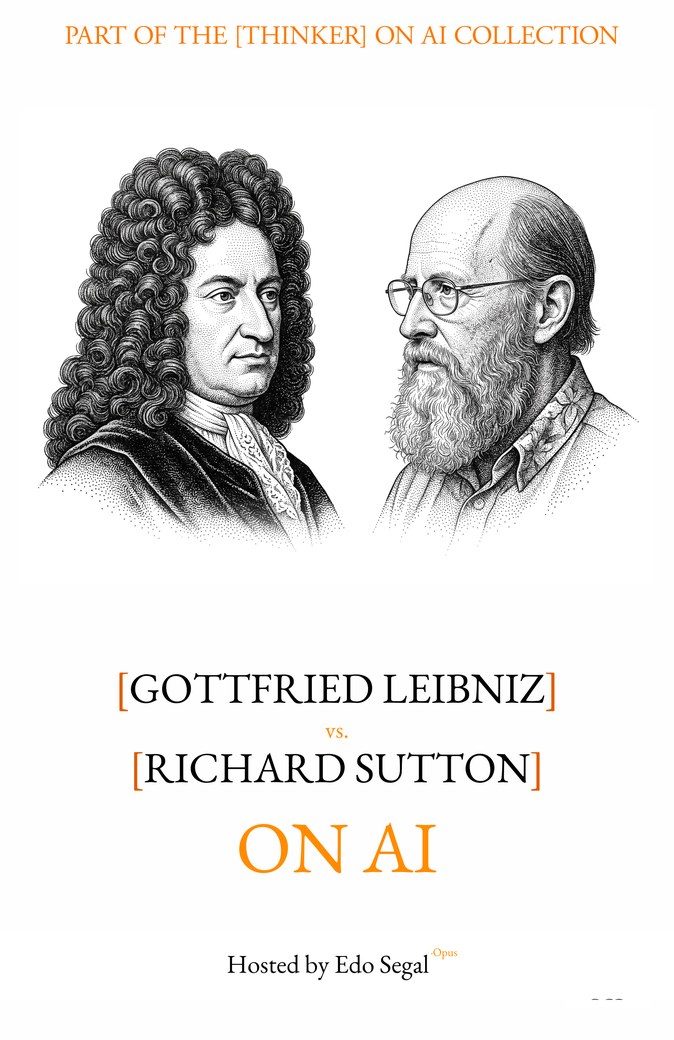
Gottfried Wilhelm Leibniz was born in Leipzig in 1646 and died in Hanover in 1716. He invented the calculus — published it before Newton — and the binary arithmetic of zeros and ones on which every machine in this conversation now runs. He built the first calculator that could perform all four operations of arithmetic. And he dreamed, more completely than anyone before or since, of mechanizing thought itself: a universal language in which every concept has a precise sign, and a calculus of reasoning so exact that when two people disagree they need not quarrel — they need only sit down and say to each other, let us calculate. Norbert Wiener called him the patron saint of cybernetics. He is, by any honest accounting, the author of the dream this entire field has been trying to complete for three hundred years.

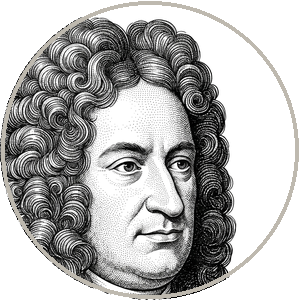 LEIBNIZ: You are generous, and I will try to deserve it. Though I should say at once — I did not finish most of what I started. It is a defect of mine the centuries have not corrected.
EDO SEGAL: We'll get to what you finished and what you didn't. Across from him — Richard Sutton. Rich spent forty years holding one idea while the field looked everywhere else: that intelligence is not a store of knowledge but an agent learning from experience, predicting the consequences of its actions, improving by trial and error and reward. He gave us temporal-difference learning, the reward hypothesis, and the essay that hangs over this whole evening like weather — the Bitter Lesson, which reads seventy years of AI history and finds a single verdict: every time we built our own knowledge into our machines by hand, a more general method that simply searched and learned at scale eventually beat it, by a large margin. In 2024 they gave him the Turing Award. And then he stood up, at the moment of his field's greatest apparent triumph, and called its proudest systems a dead end.
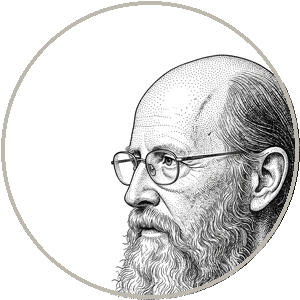 SUTTON: That's about right. Though "dead end" gets quoted like I think they're useless. I don't. I think they're a way station that people have mistaken for the destination. There's a difference, and the difference is the whole argument.

EDO SEGAL: It is the whole argument, and I want to honor it for three hours. So — the rules of the evening, and there are only three. First: we have three hours, which means nobody has to win by the next bell. Long form exists so you can let an argument breathe before you strangle it. Second: I declare my bias at the door. I started in Assembler, hand-writing meaning into a machine one instruction at a time, which makes me Leibniz's son by temperament — and I've spent the last few years watching everything I built by hand get outrun by things that were merely trained, which makes me Sutton's by evidence. I am split down the middle, and I'll tell you each time the seam shows. Third: at the end, nobody pretends. If the disagreement survives three hours, we hand it to the reader intact. Either of you may add a rule.

SUTTON: One rule. When either of us says a system "knows" something, or "understands," or "reasons" — we have to say in virtue of what. What experience produced it, what it would do differently if the world pushed back. I've spent my life watching people put a word on a behavior and think they'd explained it.
LEIBNIZ: I accept that gladly — it is half my own program; I wished every term to be cashed out in primitives. But let me add the other half, in fairness. When Mr. Sutton says a thing was learned and not built in, I want him to say what the learning rests on. For every learner begins somewhere. The infant is not a blank slate; it arrives with a form that makes learning possible at all. I will grant that knowledge can be acquired. I ask only that he grant that the capacity to acquire it was, in some sense, engineered — by nature if not by us. There is always architecture under the experience.
SUTTON: That's fair. There's architecture. I just think it's a much smaller, more general thing than you want it to be — and that almost everything interesting is in the experience, not the architecture. But yes. Granted. There's a floor.

EDO SEGAL: Mark that — we have a rule from each of you, and they're already the same disagreement in two coats: how much is the floor, and how much is the climb. Now, before openings, the strange thing about this table has to be named, because the reader can feel it. Gottfried — you have been briefed on the present. You have been shown what a transformer is, how it's trained, what it can do. You're reacting to a 2026 you did not live to see.

LEIBNIZ: I am, and I will tell you it is the most extraordinary three hundred years a man ever slept through. I asked to be shown the inside of one of these machines — I have always wanted to walk inside the thinking machine; I once described doing exactly that, imagining a mill one could enter. And they showed me, and it was precisely as I had predicted and far worse than I had feared. But I am getting ahead. Give me the floor in its proper turn.
EDO SEGAL: I will. One last thing, so the stakes are not abstract. Gottfried, you believed mechanizing reason would end discord — that calculation would replace the clamor of human disagreement with the quiet of computation. Rich, you've spent a career insisting the opposite of the rationalist's confidence: that our introspective sense of how our own minds work is an unreliable guide to building minds, that we should distrust exactly the clever knowledge we're proudest of. One of you thinks the mind can be spelled out. The other thinks the most important things about it can only be discovered, and that trying to spell them out is the mistake. So here is the question on the table, stated once, plainly, because every round tonight is this question wearing a different coat. When you reach the floor where the machine starts to know — do you climb by engineering reason in, or by getting out of the way and letting it learn? Gottfried Leibniz. The floor is yours.