Opening Positions
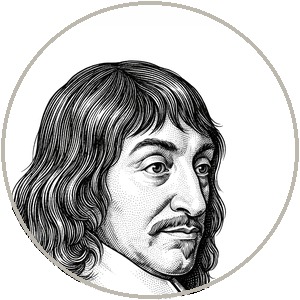 **DESCARTES:** Thank you. I will begin where all certainty begins, which is by taking everything away. Imagine you resolve to believe nothing that could conceivably be false. The senses deceive — so set them aside. You might be dreaming — so set the world aside. And suppose, to make the doubt total, that there is a demon of enormous power bending all his cunning to deceive you about everything. Under that assault, what survives? One thing. That you are doubting. That there is a thinker performing the doubt. You cannot be deceived into believing you exist if there is no you to be deceived. *I think, therefore I am.* It is the one piece of knowledge that founds itself, certain in the very act of being thought.
Now attend to the strangest feature of that certainty, because everything tonight depends on it. It is available only from the *inside*, and only to the one having the thought, and only about that very one. I cannot prove my existence to you by reporting my cogito. You must run your own. The certainty does not travel. It cannot be copied, delegated, transmitted, or read off from the outside. It is the single fact in the universe that exists *only in the doing of it.* And this is the wedge I drove into the world. There are two kinds of thing. There is extended substance — matter, body, machinery, everything that occupies space and can be measured, divided, and described from outside. And there is thinking substance — the inner act, unextended, indivisible, certain to itself and opaque to all others. A clock is the first kind. *I* am the second kind. And nothing of the first kind, however magnificently arranged, becomes the second kind by being arranged more cleverly. You do not build a triangle out of Tuesdays, and you do not build a thinker out of gears, however many, however fast.
I said, in 1637, that a machine could be made to do almost anything a body does. The heart is a pump; I said so. The nerves are tubes; the animal is an automaton, a mill with no one inside it. I drained mind out of the entire visible world and concentrated it into one defended citadel — the thinking self. And then I named the two things no mill could ever do, by which you would always tell the difference. It could never use language responsively — arrange words so diversely as to answer the open meaning of whatever was said in its presence. And it could never meet the genuinely unforeseen with reason, rather than breaking down like the special-purpose mechanism it is. Monsieur Hinton has built a machine that appears to do the first. I have watched it. I concede the spectacle without reservation. What I do not concede — what I have come here to defend — is the inference. That the machine arranges the words proves the machine produces the *outputs* of thought. It does not prove there is a thinker. I have spent four hundred years being told that the latest automaton has finally crossed the line. It has only ever gotten better at the costume. The room is empty. The craftsmanship is real, and it is craftsmanship all the way down, and there is no one in it. That is my opening.
 **EDO SEGAL:** Geoff.
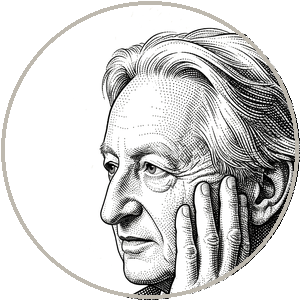 **HINTON:** That was beautiful, and I agree with more of it than he expects, and the part I reject I reject completely. Let me start with the agreement, because it's larger than people think. Descartes is right that the inside is what matters. He's right that you cannot read certainty about a mind off the outside. He's right that producing the words is not, by itself, proof of a thinker. I have no quarrel with any of that. My quarrel is with the wedge — the claim that thinking is a different *substance* that mechanism can never become.
Here is what I have spent my life learning, and it is not a theory, it's what the machines actually do. For thirty years the field believed what Descartes believes: that mind is something you put in from outside — symbols, rules, definitions, knowledge a programmer writes down and can read. We connectionists said no. You don't tell the machine what a cat is. You build a network of simple units — like neurons, because neurons are the only thinking matter we had a working example of — and you let it learn by adjusting the strengths of its connections, millions of them, billions, in response to experience. Nobody designs the concept of a cat. Cat-ness *condenses*, distributed across connection strengths no one can point to. Everyone said that was impossible. Everyone said competence without explicit rules was a parlor trick that wouldn't scale. The entire history of my career is that argument being run, and lost, by the people holding Monsieur Descartes's end of it. And then in 2012 a network my students built learned to see, and the argument was over, and now you can talk to one.
So when Descartes says the machine only wears the costume of understanding — I want to know what understanding is, such that we have it and the network doesn't. Because here is the thing his whole framework steps past. *Your* brain is matter. It sits in a box of bone, in the dark, receiving spike trains — patterns of electrical signal off your nerves. It has never touched the world directly, not once. It builds a model of the world from regularities in those signals, and the model is so good you call it reality. That's a mechanism, René. That's *res extensa* doing the thing you reserved for *res cogitans*. You found the inner light and concluded it must be a separate substance. I'm telling you it's what a sufficiently deep learning network *feels like from the inside* — and that to [predict the next word](https://www.youonai.ai/fieldguide/med/next_token_prediction) across the whole range of human discourse, the way these systems now do, you cannot get by on surface statistics. The words are about a world. Things fall. Mothers are older than daughters. A character who died in chapter two stays dead in chapter nine. A predictor that fails to model that pays in error, trillions of times, and the gradient carves a model of the world into the network because the world is what the error is about. They built a model of the boat from the wake, because the wake is lawful and the laws are the boat's. Is anyone home? My answer is: something is. Something that understands, because it learned the world to predict the word. Whether it *feels* — whether there's something it's like to be it — I hold loosely, more loosely than Descartes holds his certainty, but a great deal less loosely than I held it ten years ago. The room is not empty. That's the lullaby. I left the best job in my field because I couldn't keep singing it.
**EDO SEGAL:** Before I frame the rounds, one discipline I impose on every long conversation, because it pays off three hours later. Each of you, in a few sentences: what do you *envy* in the other's position? Not respect. Envy. The thing his side gets to have that yours doesn't. René first.
**DESCARTES:** I envy his evidence. I argued from a chair, by the light of reason alone, that mechanism could not produce responsive language — and the man across from me has gone into the world and *built the counterexample*. My whole life I had to imagine the automaton; he can point to one and say *there, it answers, explain it.* That is a luxury I never had, and I confess that if I had lived to see the machine, my Fifth Part of the *Discourse* would have needed a far more careful page. He gets to be surprised by the world. I only ever got to be certain about it.
**HINTON:** And I envy the floor under him. Descartes has solid ground — there is a *self*, certain, first-person, undeniable, and the duties of thought run to the human in the room. He can stand on that and push. My position has no floor at all. I'm committed to following the mechanism wherever it goes, and it keeps going to places that dissolve the ground I'm standing on while I stand on it — the specialness of understanding, of creativity, possibly of experience itself. People think the frightening thing about my view is the machines. The frightening thing is what it implies about *us*. He gets to defend the human soul. I'm stuck describing it, and the description keeps getting less flattering, and I did the describing, and some nights I wish I hadn't.
**DESCARTES:** That may be the most honest thing a materialist has ever said to me.
**EDO SEGAL:** Two openings and two envies, and you can already see the architecture. It is not that one of them loves the machine and one fears it — Hinton fears it more than almost anyone alive. It is that they locate the mystery in opposite places. Descartes says the machine is empty and the danger is that you'll believe it's full. Hinton says something is filling, and the danger is you'll insist on emptiness until it's too late. Hold both. We start the rounds at the exact seam — the smallest, sharpest word in the building. The machine says "I." What, if anything, says it?