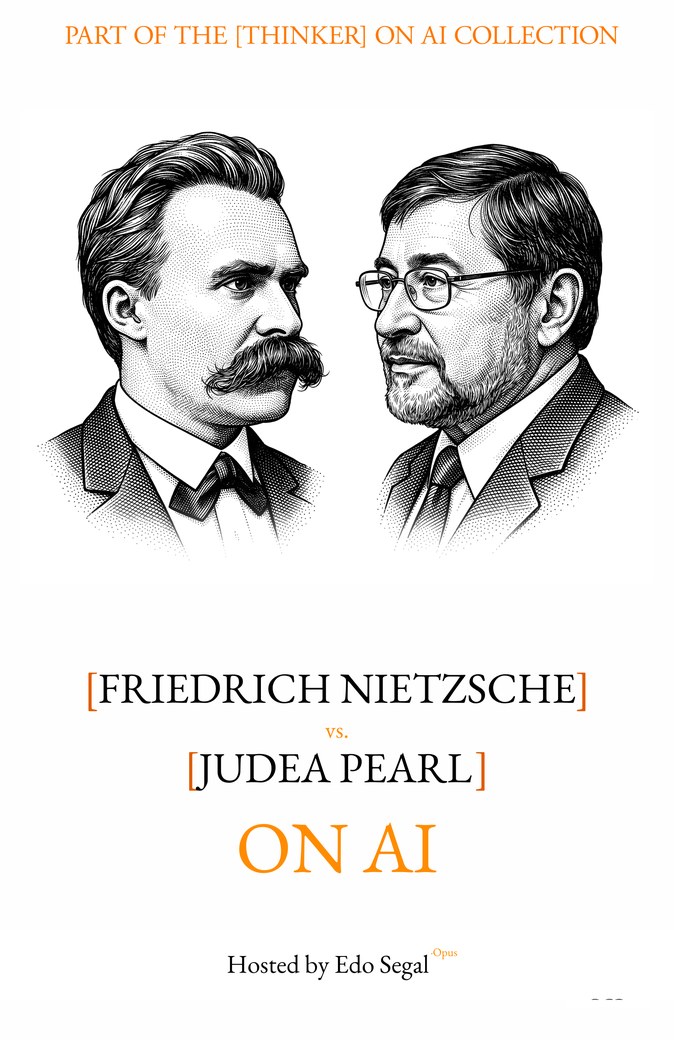
The Question on the Table
 **EDO SEGAL:** Somewhere tonight, in a data center I will never see, a machine is being handed a goal and left alone with it. Book the trip. Find the bug. Win the game. And it sets off — pursuing, backtracking, abandoning one route for another, surprising the engineer who set it loose. A few years ago that engineer would have called what the machine was doing "search." Tonight he catches himself, more and more, calling it "deciding." The word slips out before he can stop it. And the moment it does, a trapdoor opens under the whole enterprise, because if the machine is *deciding*, then something is doing the deciding — and we are owed an answer about what, exactly, is home behind the choice.
I have built these systems with my own hands, and I will confess the vertigo before I ask anyone else to. When the machine chooses a path I did not author, I feel the floor move. And then it moves a second time, worse, because the question turns around and points at me. When *I* choose — when I decide to keep these two men talking for three hours instead of going to bed — is there anyone home behind that, or am I also a process that learned to narrate itself as a chooser?
I can think of no two people who have thought harder about that trapdoor, from more opposite directions, than the two men at this table.
Friedrich Nietzsche needs no defense of his right to be here, only a warning. He was a philologist at twenty-four, the youngest ever to hold the chair at Basel, and a wandering invalid for most of the years that mattered, writing some of the most alive sentences in any language between bouts of a sickness that nearly killed him daily. He took a hammer — not to smash, he insisted, but to *sound*, the way you strike an idol to hear whether it rings hollow — and he struck the most cherished idol of all: the free, unified, sovereign self at the controls of a human being. He found it rang hollow a century before anyone could build a machine to make the question urgent.
 **NIETZSCHE:** You have already flattered me into a corner, which I notice is your method. Strike on.
**EDO SEGAL:** Judea Pearl built the thing Nietzsche only described — a mathematics of how one event makes another happen. For most of the twentieth century, serious scientists whispered the word *cause*, if they said it at all; statistics had been built on a famous refusal, correlation is not causation, and Pearl broke the taboo by out-rigoring it. He gave artificial intelligence its first disciplined grip on uncertainty with Bayesian networks, and then he did the harder thing: he gave causation itself a calculus, the do-operator, the [ladder of causation](https://www.youonai.ai/fieldguide/med/causal_theory_vs_data) — seeing, doing, imagining. For that he won the Turing Award. And he has spent his later years as the field's most precise critic, telling a triumphant industry that its dazzling machines are stranded on the lowest rung, mastering pattern while understanding nothing.
 **PEARL:** That is accurate, and I would only add that I am not here to bury the machines. I am here to locate them. There is a difference, and the difference is the whole evening.
**EDO SEGAL:** Then the rules, and there are three. First: we have three hours. Nobody must win by the next bell — the point of long form is to let an argument breathe before you strangle it. Second: I declare my bias at the door. I build with these systems daily, I wrote a book with one, and I have a stake in this question on both sides of my own chest. Third: if the disagreement is still standing at the end, nobody shakes hands and pretends. We hand it, intact, to the reader. Either of you may add a rule.
**PEARL:** One. When a word is used — *agency*, *choice*, *will*, *understands* — I want it cashed out in mechanism. Not in feeling. Tell me what computation the word names, or do not use it as if it named one.
**NIETZSCHE:** A fine rule, and I accept it, with its mirror image attached. When *you* say "mechanism," Doctor, I will ask what feeling, what need, what will-to-be-safe made you reach for that word and call it neutral. The duty runs both directions. You will demand I cash out my ghosts. I will demand you cash out your confidence that you have banished them.
**EDO SEGAL:** I should say one strange thing about this room before we begin, for the reader's sake. Friedrich, you died in 1900. You never saw a vacuum tube, let alone a transformer. For tonight you have been briefed on the whole present — you know what a neural network is, what these systems do, what a trillion dollars leaving the software industry meant. You will react in character, which is the only honesty available to us.
**NIETZSCHE:** I was a philologist; I have spent my life reading the dead and making them speak to the living. Now I am the dead, and you have made me speak. There is a justice in it I find almost amusing. Yes — I know what your machines are. I have known what they *were* for a hundred and twenty years. You only just built the proof.
**EDO SEGAL:** So here is the question on the table, stated once, plainly, because every round we fight tonight is this question wearing a different coat. When the machine starts to choose, is anyone home behind the choice — or is "free will" just a grammar trick you must outgrow to climb higher? Judea, before opening statements, the naive version, so the whole room is oriented. Your machines today — do they choose anything at all?
**PEARL:** No. Not in any sense that earns the word. A system trained on a frozen ocean of text and pixels does one thing magnificently: it detects what goes with what. It sees. It does not do, and it cannot imagine the world as it is not. When it appears to choose, it is selecting the continuation that best fits the patterns it has absorbed — it is fitting a curve through a space you cannot picture, and calling the brightest point "a decision." There is no model of the world behind it, and certainly no model of *itself* as an agent whose acts could have been otherwise. So: nobody home. But — and Friedrich will hate this — that is a fact about *these* machines, not about agency. Agency is real. It is buildable. We have simply not built it yet.
**NIETZSCHE:** And there, in the second breath, you let the ghost back into the room you just swept. "Agency is real, we have not built it yet." You speak as though there were a clean, true *agent* waiting in the design space — a chooser without illusions — and the only trouble is the wiring. I will spend three hours telling you that the chooser you mean to build was never in *us* either. There is no neutral doer behind the deed. You did not find the agent and decline to build it. You inherited a grammar that needs a subject for every verb, and you mistook the grammar for a discovery.
**PEARL:** Then we have our evening, because that is precisely the claim I think I can refute with mathematics rather than mood.
**EDO SEGAL:** One of you thinks the chooser is a fiction the machine merely exposes. The other thinks the chooser is a real machine we have not yet assembled. And the worst outcome of tonight would be the reader deciding the truth is comfortably in between. Opening statements. Friedrich, the floor is yours — you have been waiting a century.