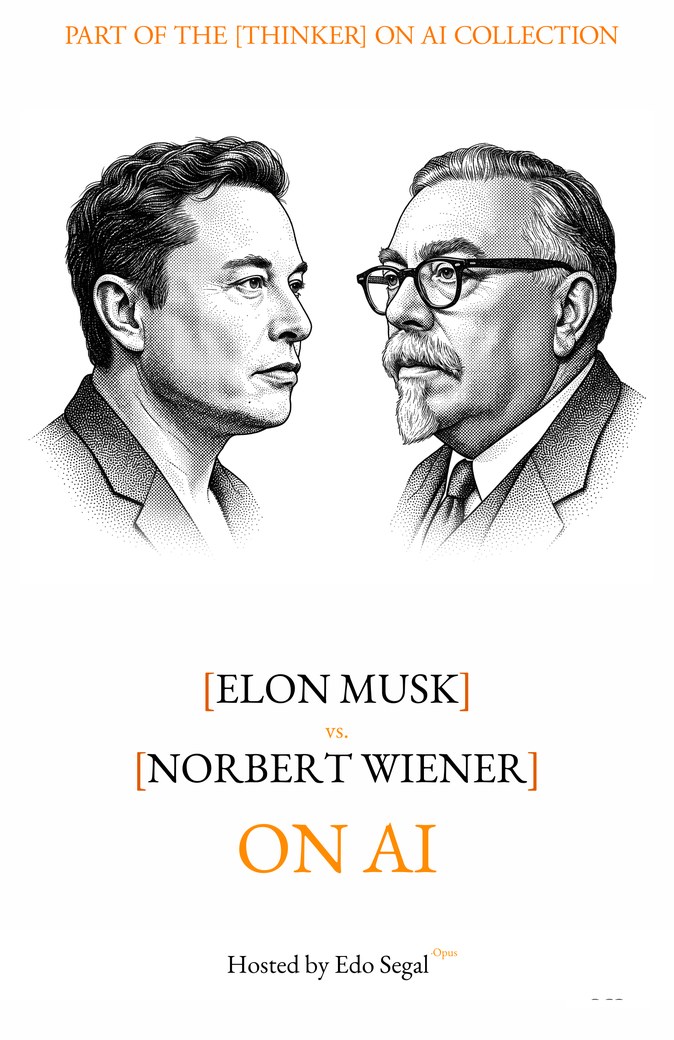
The Question on the Table
 **EDO SEGAL:** Somewhere in the world right now, in the time it takes me to say this sentence, an automated system is making a decision no human will see until it is finished. A trade clears in a microsecond. A content filter removes a video. A model in a car decides the object ahead is a shadow and not a child, or a child and not a shadow, and acts on the answer before any foot reaches any pedal. We have spent seventy years building machines that act faster than we can watch them act, and we have told ourselves a story the whole time — that we are still in charge, because the off switch is right there, because a human is in the loop, because if it ever went wrong we would simply reach in and stop it.
Tonight I want to put that story under a light, with the two men best equipped on earth to break it. The question is this, and I'll state it once, plainly, because every round we fight will be this question wearing a different coat: when you hand a faster mind the wheel, at what speed do you lose the right to grab it back — and have you already passed it?
I have wanted this conversation for a long time, and I had to bend the rules of physics to get it.
Norbert Wiener is the founder of cybernetics — the science of control and communication in the animal and the machine. He coined the word, in 1948, from the Greek for *steersman*. He was a prodigy of almost mythic proportions: reading at three, in college at eleven, a Harvard doctorate at eighteen, formed by Russell at Cambridge and Hilbert at Göttingen. During the war he built the mathematics of the machine that aims itself — the gun-director that predicts where the aircraft will be and fires there, with no human in the moment of decision. And then, after Hiroshima, he did the rarest thing a founder has ever done: he refused to weaponize his own work, and spent the rest of his life insisting the question was never whether we *could* automate, but whether automation would serve human beings or consume them. He died in 1964. So I should say plainly to the reader: Professor Wiener has been briefed on the present. He knows what a transformer is, what a frontier lab is, what it means that a model company is now worth more than the country he was born in. He has read the road we drove down after he got out of the car.
 **WIENER:** I have read it, and I will say at the outset that very little of it surprised me. The materials are new. The mistake is old.
**EDO SEGAL:** Elon Musk needs no introduction, and that is its own kind of problem, so let me give the one that matters for tonight. He has built rockets that land themselves, cars that drive themselves, and — this is the part that brings him to this table — he is among the very few people alive who has said, in public, that artificial intelligence is the single greatest existential threat to our species, called it summoning the demon, put the risk of catastrophe in real numbers. And then founded a lab to build it. Twice. He is the man who looked into the abyss Professor Wiener mapped, agreed it was an abyss, and decided the only safe response was to get there first.
 **MUSK:** That's roughly fair, though "get there first" is too simple. The point isn't to win a race for its own sake. The point is that the race is happening whether I'm in it or not, and the question is whether the leading AI is built by people who are terrified of it or by people who think it's just another product. I'd rather be terrified and in the lead. But I'll grant you the tension. I live inside it. I don't pretend it resolves.
**EDO SEGAL:** Good, because the format depends on the tension not resolving. So here are the rules of the evening, and there are only three. First: we have three hours. Nobody has to win by the next bell — the whole point of long form is that you can let an argument breathe before you strangle it. Second: I declare my bias up front. I build with these systems every day, I have my hand on this throttle nightly, and I have felt both the exhilaration of the wheel responding and the cold moment of realizing a loop got away from me. Third: at the end, nobody shakes hands and pretends. If the disagreement survives three hours, we hand it to the reader, intact. Either of you may add a rule of your own.
**WIENER:** I will add one. We must define our speeds. The entire confusion of this subject, in my time and apparently in yours, lives in the word *control* used without a clock attached to it. When Mr. Musk says he keeps control, I want to know: control at what latency? A man controls a thermostat across minutes. He does not control a [feedback loop](https://www.youonai.ai/fieldguide/med/feedback_not_control) that completes its action in milliseconds, no matter how firmly he believes he does. Every claim of control tonight should be made to state the speed at which it is claimed, or it should be ruled out of order.
**MUSK:** I'll accept that, and I'll hold you to the reverse. You keep talking about speed foreclosing intervention. Fine. But control isn't only about reaching in *during* the action. It's about who designed the system, what objective is in it, whether there's a kill mechanism built in from the start. I'd add the rule that we distinguish control-during from control-before. Because I think you're going to use the first to deny me the second, and they're not the same thing.
**WIENER:** They are not the same thing. On that we will agree more than you expect, and it will not comfort you.
**EDO SEGAL:** You see why I wanted this. Before the opening statements, one image on the table, because it is the frame this whole series climbs inside, and both of you will have to take a position on it. In [YOU] on AI I argued that intelligence is less a possession than a [river](https://www.youonai.ai/fieldguide/med/river_of_intelligence) — a current that has flowed and found new channels through chemistry, biology, language, culture — and that something new has entered the water. The book's whole architecture, the tower and the staircase, the death cross where capability crosses you, rests on the claim that what entered is real and is fast. Elon, you'd say the river is accelerating and we'd better surf it. Professor Wiener, I suspect you'd say the river was always the point — that you named the steersman precisely because the water was already too fast for the hand.
**WIENER:** I named the steersman because the steersman is the hardest job, not the safest one. A man at a tiller in a slow canal has the illusion that he commands the water. Put him in a torrent and the tiller still moves in his hand, and he still feels himself steering, and the river takes him exactly where the river was going. The dangerous moment is not when he loses the feeling of control. It is when he keeps the feeling and loses the thing.
**MUSK:** And my answer is that you can build a better boat. That's the whole disagreement in one sentence. Wiener looks at the torrent and says the tiller is a lie. I look at the torrent and say: then engineer a hull that holds, put redundancy in the rudder, and for God's sake be the one steering instead of the guy who thinks the river is friendly. The river doesn't care about us — he's right about that, it's the truest thing he's said. But "the river doesn't care" is an argument for building harder, not for despair.
**EDO SEGAL:** Then we have our evening. One man says the tiller is a lie at speed. One man says build a better boat. And neither of you, I'll note for the reader, is the optimist — you'd both tell me to be afraid. You locate the danger in different places, and where you locate it determines whether the cure is to slow down or to build faster. Hold that. So here is the question on the table once more, because we return to it at every floor: when you hand a faster mind the wheel, at what speed do you lose the right to grab it back — and have you already passed it? Professor Wiener, by seniority and by sixty years of waiting, the floor is yours.