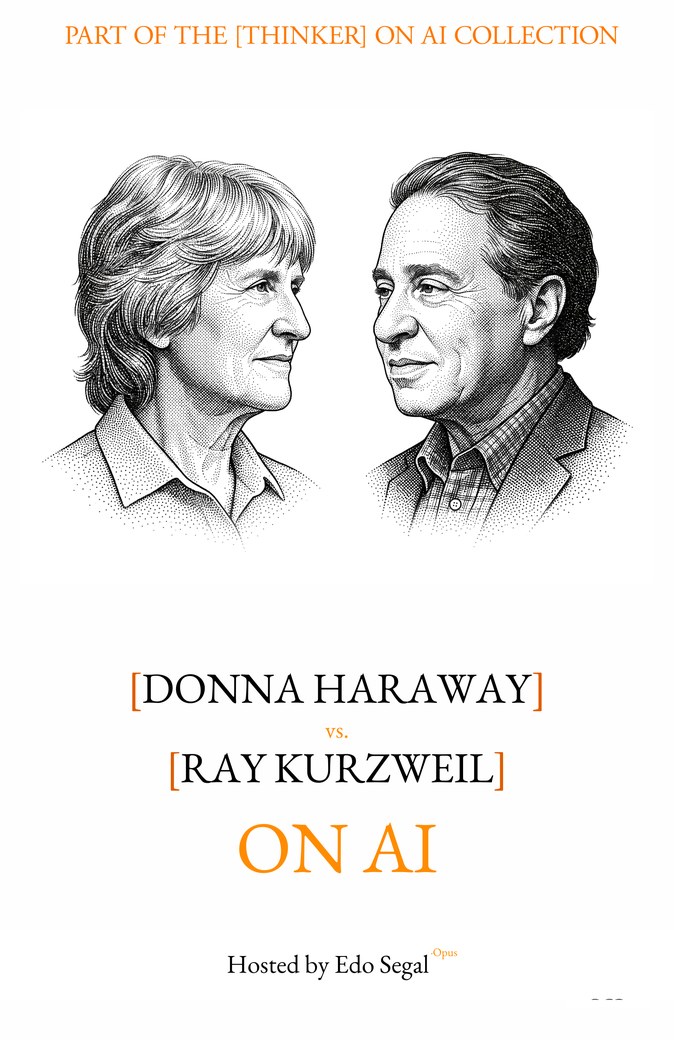
The Question on the Table
 **EDO SEGAL:** Start the clock far out, the way I always do, because the small thing only means something once you've seen the large thing it sits inside. Thirteen point eight billion years ago hydrogen cooled out of plasma and started keeping a kind of records — the structure of an atom is already information, already a pattern that holds. And then, very late, a few minutes ago in cosmic time, one of those patterns sat down at a screen at three in the morning, described a half-formed idea to a machine, and felt the machine hand it back clarified, connected, *more*. That pattern was me. The house was silent. And the thing I felt — I have never fully gotten over it — was that the boundary between where I ended and where the tool began had gone soft.
That softness is the whole evening. Because the next thing that happens, when the boundary goes soft, is that someone asks: then what are *you*, exactly? The part that can be amplified? The part that can be copied? Or the part that bleeds, and gets tired, and has to be somewhere, and can be blamed? I have wanted to host this particular fight for years, because I can think of no two people alive who have stood at that softened boundary longer, or come away with more opposite answers.
Donna Haraway is a biologist who became a philosopher of science, and one of the most consequential thinkers of the last half-century on what we are when we are entangled with our tools. In 1985 she published "A Cyborg Manifesto," and most people who quote it get it exactly backwards — they think the cyborg was a celebration of leaving the body for chrome and circuitry. It was the opposite. The cyborg was her figure for staying: for refusing the myth of a pure human self that machines contaminate, for living honestly in the seam, mongrel and accountable. She gave us situated knowledges, companion species, the discipline she calls staying with the trouble, and the line I cannot stop thinking about — that she is not posthuman, she is compost. Donna, thank you for being here.
 **HARAWAY:** Thank you for getting the manifesto right in the first thirty seconds. That almost never happens. Usually I have to spend an hour digging the cyborg out from under everyone's Terminator.
**EDO SEGAL:** Ray Kurzweil needs less introduction and more, because the scale of the claim resists summary. He noticed, decades before almost anyone, that the price-performance of computing had been improving exponentially since the 1890s through five entirely different hardware paradigms, and he turned that into the [Law of Accelerating Returns](https://www.youonai.ai/fieldguide/med/law_of_accelerating_returns) — the argument that information technology doesn't just improve, it improves at an accelerating rate, because each generation builds the tools for the next. He has been predicting, with a track record that embarrasses his critics, that machines would master our language right about now, that artificial general intelligence arrives around 2029, and that somewhere in the 2040s biological and non-biological intelligence merge into something that transcends both. Ray, welcome.
 **KURZWEIL:** Thank you, Edo. And I want to say at the start — I've read Donna's work, and I have more respect for it than she may expect. We disagree about almost everything that matters. But we are at least disagreeing about the *real* thing, which is rare.
**EDO SEGAL:** That's the format, so let me set the rules, and there are only three. First: we have three hours. Nobody has to win by the next bell — the whole point of long form is that you let an argument breathe before you decide whether to strangle it. Second: I declare my bias at the door. I build with these systems every day, I wrote a book with one, and I have skin on both sides of tonight's question — I have felt the merge Ray promises, and I have a body and children that make me suspect Donna is right that the merge has a cost somebody pays. Third: at the end, nobody shakes hands and pretends. If the disagreement survives three hours, we hand it to the reader, intact. Either of you want to add a rule of your own?
**HARAWAY:** One. We don't get to use the word "we" without saying who's in it. Half of what I'll be fighting tonight lives in that little word. "We will transcend biology." Who is the we? The man in the lab, or the woman whose labeled data trained the model, or the child whose attention is the product? The "we" is never everybody. I want it itemized.
**KURZWEIL:** I accept that, and I'll add one. We don't get to use the word "just" without earning it. "It's *just* statistics." "You're *just* a pattern." "Consciousness is *just* neurons." Every time someone says "just," they're smuggling a whole metaphysics through customs without declaring it. If Donna gets to charge for "we," I get to charge for "just."
**EDO SEGAL:** Two rules, two taxes, and we haven't started. Good. Before openings I want to put one image on the table, because it's the frame this whole series climbs inside and both of you will have to take a position on it whether you like it or not. In [YOU] on AI I argued that intelligence is less a possession than a [river](https://www.youonai.ai/fieldguide/med/river_of_intelligence) — a current that's been finding new channels for thirteen billion years, through chemistry, biology, language, culture — and that in the winter of 2025 something new entered the water. The whole book rests on the claim that what entered is real. A new participant in the medium. Ray, I suspect you think I undersold it. Donna, I suspect you think the word "participant" is already a confession.
**KURZWEIL:** I think you undersold it, yes — the river isn't just gaining a participant, it's about to change its own bed. But I'll wait for my opening to say how.
**HARAWAY:** And I think "participant" is doing a great deal of quiet work, because it's warm and it's reassuring and it makes the arrival sound like a guest at a table rather than an enclosure of a commons. But I'll wait too. I just want the reader to notice that even your metaphor, Edo, is already taking a side — rivers are *natural*, and calling this a river makes it sound like weather instead of like a decision somebody made and is profiting from.
**EDO SEGAL:** See, that's exactly why I wanted you both. One housekeeping note for the reader before we start, because it matters for what you're about to read: I've briefed both of my guests fully on the present — on the winter of 2025, on the systems running now, on each other's latest work — so when Donna reacts to a 2026 model or Ray cites a result from last month, that's real, that's them, reacting in character to the world as it actually is tonight. Nothing here is frozen in the year either of them last published.
Now. Here is the question on the table, stated once, plainly, because every round we fight tonight is this question wearing a different coat. When the machine fuses with you — and it is fusing, the boundary is already soft — do you climb out of the body to escape it, or stay inside it, mongrel and mortal, to mean anything at all? Put differently, the one neither of you can dodge: after the merge, is there still a *you* who can be held responsible — and is that *you* the animal, or the pattern? Donna Haraway, the floor is yours.