The Question on the Table

 EDO SEGAL: Somewhere in the world, in the time it takes me to say this sentence, a few million people are merging with a machine and not noticing it happen. A designer in São Paulo finishing a thought she could not have finished alone. A teenager in Manila asking the box, at midnight, who he should be. A man my age, who should know better, typing a half-formed idea into the screen at three in the morning and feeling it come back to him clarified, connected, almost loved. None of them experiences a boundary being crossed. That is the whole point. The fusion is frictionless. It feels like nothing — and it feels like everything — and afterward they are, in some way they cannot name, no longer entirely the people who sat down.
That softness, that crossing-without-a-border, is what I wrote a book about and what I cannot stop being frightened by, and the two people I have wanted in this room for two years are the two people on earth who hear that softness most clearly and most differently. So here is the question we will spend three hours inside, and I will state it once, plainly, because every round tonight is this question wearing a different coat: when the machine fuses with you, are you becoming freer and stranger — or are you just being wired more tightly into someone else's tower?
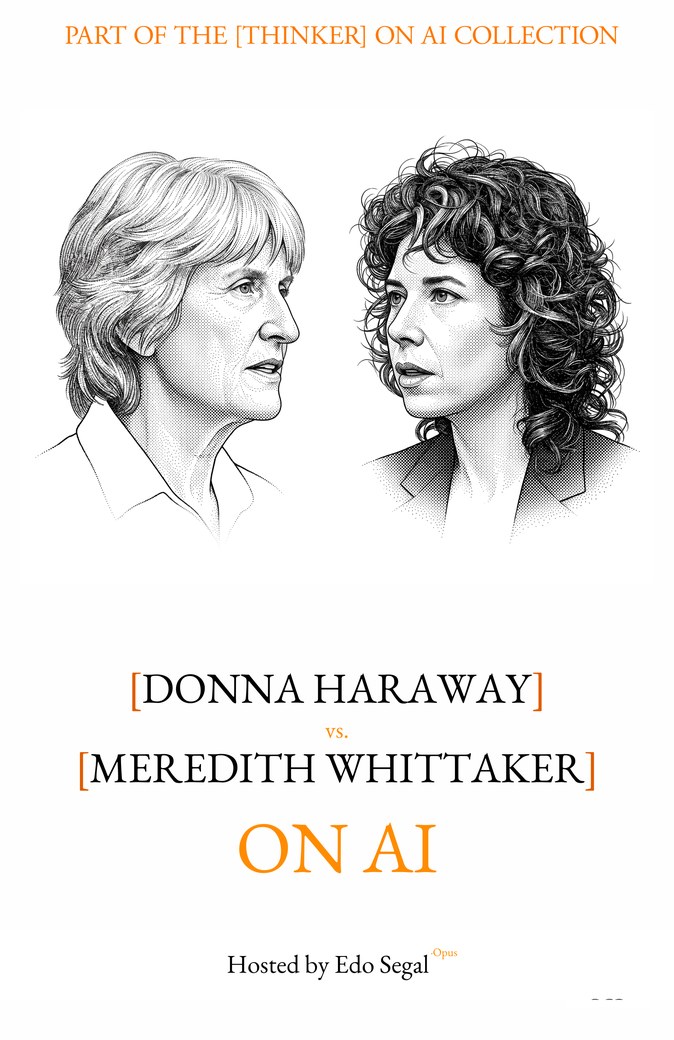
Donna Haraway is the reason I have the word "cyborg" to think with at all. A biologist who became a philosopher of science, she published, in 1985, "A Cyborg Manifesto" — not a prediction about robots, but a blasphemy aimed at everyone who believed there was some pure human self that machines could only contaminate. The cyborg, in her hands, was never chrome and circuitry. It was the recognition that we are already hybrids, already constituted by our entanglements, and that the dissolving of the old boundary is a liberation from the myths of purity that have been used, for centuries, to cage us. Companion species, situated knowledges, the god trick, staying with the trouble, compost — she has spent forty years building the most precise vocabulary we have for what is happening to us now.
 HARAWAY: And I'll warn you at the door, Edo — I did not come here to be optimistic. People hear "liberation" and think I'm selling them a happy ending. I'm selling them trouble. Good trouble, the kind you stay with.
EDO SEGAL: I'm counting on it. Meredith Whittaker comes to this table from inside the machine, which is the rarest credential in the room. She spent more than a decade at Google, founded its Open Research group, and then, in 2018, helped organize twenty thousand of her colleagues to walk out the door over military contracts and a culture of impunity. She co-founded the AI Now Institute, advised the FTC, and now leads the Signal Foundation — anti-surveillance infrastructure, built to prove the surveillance business model is a choice and not a fate. She wrote "The Steep Cost of Capture." She is the person who, when everyone else is debating the machine's soul, points at its ownership.
 WHITTAKER: I'll take "points at its ownership." I'd only add — I'm not the skeptic in the corner who never built anything. I built plenty. That's exactly why I won't romanticize what I built it for.
EDO SEGAL: Which is why I wanted you both. Let me set the rules of the evening — there are three, and then you each get to add one. First: we have three hours, which means nobody wins by the next bell. Long form exists so an argument can breathe before anyone strangles it. Second: I press both of you, and I declare my bias up front — I build with these systems daily, I wrote a book with one, and I have skin in this on both sides of my own heart. Third: if the disagreement survives three hours, we hand it, intact, to the reader. Donna, your rule?
HARAWAY: Stay material. No floating. Every time one of us says "the machine does" something, somebody at this table has to be able to say which machine, made by whom, running on whose water and whose labor and whose stolen text. I am a feminist and a biologist before I am anything else, and both of those disciplines teach you that abstraction is where the bodies go to disappear. So: no disappearing the bodies.
WHITTAKER: I'll sign that one, and I'm a little startled to be signing one of Donna Haraway's rules so quickly. Mine is adjacent. Every time we use a word borrowed from human life — "understands," "learns," "collaborates," "merges" — somebody has to ask who profits from the borrowing. Not whether it's true. Who profits. Because in my experience the words that thrill us are doing financial work before they do any philosophical work.
EDO SEGAL: Two rules about where the bodies go and where the money goes. You see why this evening is going to hurt in the good way. Before opening statements, one image on the table, because it's the frame the whole series climbs inside, and both of you have to take a position on it. In [YOU] on AI I argued that intelligence is less a possession than a river — a current that has been finding new channels for a very long time, through chemistry, through biology, through language — and that in the winter of 2025 something new entered the water, and the boundary between us and it began to dissolve. Donna, I suspect you hear that as your manifesto finally becoming flesh.
HARAWAY: I hear it as a man who wrote my argument in 1985's language without knowing he was quoting me, which delights me, and as a man who then reached for a river so he wouldn't have to feel how strange the water is, which worries me. The boundary was never where you drew it, Edo. The river is real. But rivers have banks, and dams, and owners now, and that's where I'll want to push.
EDO SEGAL: Meredith?
WHITTAKER: I hear a beautiful sentence that does a specific job, which is to make a corporate product sound like a force of nature. "Something entered the water." No. A handful of companies that already owned the surveillance infrastructure of the last two decades poured a trillion dollars into building it, scraped the commons to feed it, and released it because it serves their business model. Nothing entered anything. Somebody did this, on purpose, and I can tell you their names. The river didn't dissolve your boundary, Edo. People with shareholders dissolved it, and they'd like you to call it weather.
EDO SEGAL: Then we have our evening, and you've already found the seam. One more thing before openings, because the reader deserves the stakes undisguised. Donna — your stake is that the cyborg is always political, that there is no neutral hybrid, that the question is never whether we are merging but who we are becoming and at what cost to whom. Meredith — your stake is that the deepest question about AI is not what it is but who holds power, over whom, by what means. You are not here to split a difference. One of you thinks the merger could be a door into a stranger, freer, more accountable way of being part-machine, and the other thinks the door is painted onto a wall, and the worst possible outcome of tonight is the reader deciding the truth is comfortably in the middle.
HARAWAY: It is never comfortably in the middle. The middle is where you go to avoid the trouble.
WHITTAKER: And the middle is exactly where the companies want you, because a public that feels balanced is a public that doesn't organize.
EDO SEGAL: So, the question on the table, once more, plainly, because everything tonight is this question in a different coat. When the machine fuses with you, are you becoming freer and stranger — or are you being wired more tightly into someone else's tower? Donna Haraway, the floor is yours.