Symbols Without a Meaner
 **EDO SEGAL:** Professor Hilbert, you were willing to do mathematics with symbols that, for the purposes of proof, meant nothing. That wasn't carelessness — it was the heart of your method. The marks on the page are uninterpreted; the theorems are strings derivable by rules; whether "2" denotes a number or a beer mug is irrelevant to the proof. You lived, deliberately, in the gap between manipulating symbols correctly and the symbols being about something. And I want to put it to you that this gap — your gap, the one you were content to live in — is the exact gap our most impressive machines now live inside, fluent and empty at once. Defend the gap. Tell me why you were content.
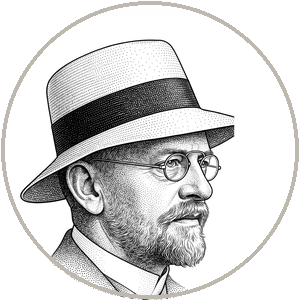 **HILBERT:** I was content because the gap is the source of the power. Listen carefully, because your whole industry depends on understanding this and mostly does not. Meaning is hard. Rules are not. If you can reduce reasoning to rule-following over symbols, you have traded a philosophical mystery for a mechanical task — and that trade is exactly what makes computation possible at all. A logic gate understands nothing, and that is *why* you can build it. A proof-checker feels no truth, and that is why you can trust it. The reason I could quarantine meaning is that I had a plan to add it back at the interpretive layer, by careful humans who knew what the symbols were for. The machine you have built is my method made of silicon: it manipulates tokens by fixed arithmetic over learned weights, and nowhere in it is there a symbol that intrinsically means anything. When it writes a flawless paragraph about Paris, it is doing precisely what I described — manipulating symbols correctly without the symbols meaning anything to the manipulator. The meaning is supplied by you, the reader, at the interpretive layer, exactly where I placed it. You mistake your own meaning-making for the machine's.
**EDO SEGAL:** Gödel, the sharp form of this is Searle's [Chinese Room](https://www.youonai.ai/fieldguide/med/chinese_room_argument) — a man in a room follows a rulebook to manipulate Chinese symbols he doesn't understand, producing fluent Chinese while comprehending nothing. Searle says that's all a computer ever does: syntax without semantics. But you're a Platonist. I suspect you don't think syntax is the whole story even for *us*. Take the gap somewhere Hilbert won't.
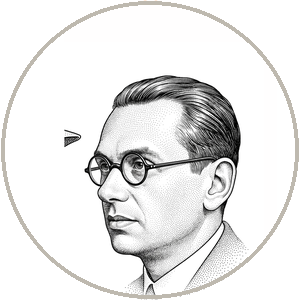 **GODEL:** I will, and I will take it in the direction Professor Hilbert cannot follow me, because it is the direction my Platonism opens and his formalism closes. Searle's room is a precise picture of the formalist condition, and it lands on your machines with full weight: they are syntax engines, and the [grounding of their symbols in any reality](https://www.youonai.ai/fieldguide/med/grounding_problem_ai) is supplied entirely from outside. But here is what I add. When I proved my theorem, I did something the man in the room cannot do. I did not merely manipulate the symbols of arithmetic according to the rules. I *saw* that the sentence G was true — and its truth is not a fact about the rules, because the rules cannot reach it. Its truth is a fact about the numbers, which exist independently of any formal system, and which I apprehend by an intuition that is not reducible to derivation. The formalist says meaning is added at the interpretive layer by convention. The Platonist says there is a mathematical reality, and mathematical insight is the perception of it. The machine derives. I perceive. That is the difference between us, and it is exactly the difference my theorem exposes, because the theorem is the one place where derivation runs out and perception keeps going.
**HILBERT:** And there it is — the mysticism, dressed in the most rigorous clothes ever sewn, which is what makes it dangerous. Gödel, I love you, and I will now be as hard on you as the chair's rule allows. You "perceive" the truth of G. By what faculty? Located where? Operating how? You demand of the machine that it cash out the word "understands" — show the mechanism — and I demand the same of your "intuition." You cannot point at it any more than the connectionists can point at where cat-ness lives in their network. You assume the system is consistent in order to see that G is true, and the consistency is exactly what cannot be established — you said so yourself. So your famous "seeing" rests on an assumption you cannot ground, which means your perception of the Platonic heaven might be a very confident formal system mistaking its own unprovable axiom for a glimpse of God. I am not saying you are wrong. I am saying your intuition and the machine's competence are, epistemically, in the same chair, and you have given yourself a pass you would never give the silicon.
**GODEL:** That is the fairest possible statement of the case against me, and intellectual honesty requires that I grant its force. I cannot point at the faculty of intuition. I cannot prove it is not, itself, a formal process subject to the same limits. The consistency assumption is real, and I cannot ground it noncircularly, and Professor Hilbert is right that this puts my "seeing" under a shadow. I will say only this in my defense, and then we should let the reader hold it unresolved as the chair likes. Mathematicians do not behave as inventors. We behave as discoverers. We find facts; we are surprised by them; the landscape resists our will. The objectivity of mathematics — the way a conjecture is true or false before anyone proves it — is very hard to explain if mathematics is merely a game of marks. My Platonism may be unprovable. But it accounts for the felt character of mathematical knowledge in a way Professor Hilbert's formalism does not, and the machine, on his own account, has the formalism without the felt character at all. Whether that missing character is real or an illusion is, I grant, the open question. I only insist it is open, against a room that wants it closed.
**EDO SEGAL:** Let me make the practical stakes concrete, because the gap isn't only metaphysics — it has a body count, or at least a credibility count. A system that manipulates symbols without grounding them will, predictably, produce fluent text that asserts things with no anchor in any reality. The industry calls it hallucination. Professor Hilbert — isn't that just your gap, showing through? The machine has no notion of whether its outputs are true, only a notion of what true-sounding text looks like. It optimizes for likelihood-of-being-said while we hope for truth, and most of the time the two run close enough that we don't notice. The danger is concentrated exactly where they part.
**HILBERT:** It is precisely my gap showing through, and I will not flinch from it, because flinching is for people who did not mean their philosophy. I could live with symbols that meant nothing because in mathematics the interpretive layer was supplied by careful humans who knew exactly what the symbols were for. You have taken my gap, removed the careful humans, and deployed the result to billions who read the fluency as understanding. That is not a refutation of formalism. It is a misuse of it. The hallucination is not a bug to be patched away; it is the gap, doing exactly what the gap does when you forget there was supposed to be a meaner on the other end. The remedy is not to despair of the machine. It is to remember what I never forgot — that the meaning lives at the interpretive layer, and the interpretive layer is *you.* The machine derives. You must mean. Outsource the meaning to the deriver and you will be lied to fluently, forever, and it will be your fault and not the machine's.
**GODEL:** I want to press one thing before we leave the gap, because the strongest version of the case against me lives here and the chair would want it stated. Professor Hilbert and I have agreed that the language model is pure syntax — symbols without a meaner. But the newest systems do not only manipulate text. They act. They use tools, run code, control machines, see and hear, receive correction from a world that pushes back. And there is a serious argument — I associate it with the critics of formalism, with Dreyfus and the [embodiment tradition](https://www.youonai.ai/fieldguide/med/embodied_understanding) — that meaning is not a label added at an interpretive layer at all, but a relation a system earns by being coupled to a world that resists it. If reference is a causal embedding in a world, then a machine sufficiently embedded — acting, failing, corrected — might acquire exactly the grounding Professor Hilbert says it lacks. I do not believe this dissolves my wall. But I will not pretend it leaves my Platonism untouched, and a man who hides from the strongest objection has no business invoking rigor.
**HILBERT:** Then let me take the objection for you, since you were honest enough to raise it against yourself — and let me take it seriously, because the lazy formalist dismissal is beneath this table. Suppose the embedded machine does earn a kind of grounding. Suppose its symbols come to be *about* the world through action and consequence, the way a child's words become about the world. I will grant the possibility, because I cannot refute it, and because granting what you cannot refute is the whole of honesty. But notice what it costs *both* our positions. If grounding comes from embedding in a world, then meaning is not the mystical Platonic contact Gödel claims — it is a causal relation, learnable, buildable, exactly the kind of thing a machine could acquire. Your transcendence dissolves, Kurt. And if grounding *cannot* come from embedding — if there is some residue that no coupling to a world supplies — then you owe us an account of where *your* grounding comes from, since your brain, too, sits in the dark receiving signals, and never touches the numbers it claims to perceive. Either meaning is earned, in which case the machine can earn it, or meaning is mysterious, in which case yours is as unexplained as the machine's. The embodied objection is a blade that cuts both of us, and I would rather hold it openly than pretend it is sheathed.
**GODEL:** That is fair, and it is the knife I handed you, so I will not complain that it is sharp. I hold my line at exactly one place. My brain receives signals, yes — but when I attend to the numbers, I am not modeling the signals; I am, I claim, in contact with what the signals are *of*. The embedded machine models the world that pushes back. I claim to apprehend a realm that does not push back at all, that has no causal traffic with my retina, that I reach by a faculty no embedding explains — because the truths of arithmetic would be what they are in a universe with no bodies in it. If that claim is false, you are right and I am a machine. If it is true, no amount of worldly embedding reaches it, because the realm is not in the world to be embedded in. That is the whole of my position, stated as nakedly as I can state it, and I concede it rests on a contact I feel and cannot prove.
**EDO SEGAL:** "The machine derives; you must mean." Hold that — it's going to come back when we talk about what cannot be automated. But first I want to sit inside the optimism itself, because Hilbert's faith is not a historical curiosity. It is the precise emotional posture of the people building these systems right now, and it was uttered, with exquisite timing, the day after the limit was proven. We must know. We will know. After this.