The Sentence That Cannot Be Proved
 **EDO SEGAL:** Kurt, I want you to do something you almost never do, which is tell the story slowly, the way you'd tell a brilliant fifteen-year-old, because most people in this audience have heard "Gödel's theorem" used as a cudgel and have never once been walked through what it actually says. September 1930. Königsberg — Hilbert's birthplace. A roundtable. You make a remark almost no one understands. The day before, in the same series of meetings, Hilbert gives the radio address that ends "we must know, we will know." Two of you in the same city, the dream and its refutation passing like ships. Tell me what you had.
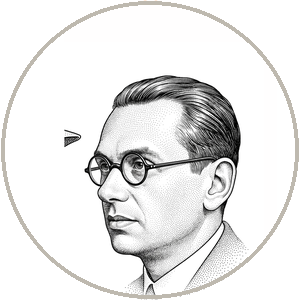 **GODEL:** I had a sentence that talks about itself. Let me build it the honest way. Take a formal system — fixed axioms, mechanical rules — strong enough to express arithmetic, and assume it is consistent, that it does not prove contradictions. I show first that the system can talk about its own syntax. Every symbol, every formula, every proof gets a unique number — what is now called Gödel numbering. Under that encoding, a statement about numbers can function as a statement about statements. Arithmetic becomes a mirror in which it can see its own structure. Then, inside that mirror, I construct a sentence — call it G — which, decoded, asserts: "G is not provable in this system." Now reason with me. Suppose the system proves G. Then it has proved something that says it is unprovable — it has proved a falsehood, and so the system is inconsistent. But we assumed it is consistent. Therefore the system does not prove G. And since G truthfully asserts exactly that — that it is not provable — G is true. The system contains a true statement it cannot prove. Completeness is impossible.
**EDO SEGAL:** And then the second blow, which is the one that hits Hilbert where he is most defended.
**GODEL:** Yes. Hilbert wanted to prove the consistency of mathematics by safe, finitary means — to demonstrate from within that no contradiction could ever arise. My second theorem shows that no consistent system strong enough for arithmetic can prove its own consistency. The certificate Hilbert wanted most — a proof of soundness established by the system's own trusted methods — is precisely the thing that cannot be obtained. If a system could prove itself consistent, that would be a sign it was not. Mathematics cannot pull itself up by its own bootstraps.
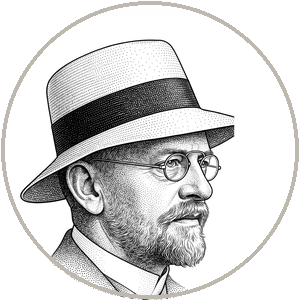 **HILBERT:** I received that news, when I was alive, with anger. I will not pretend otherwise tonight; the record is the record, and I was told I was visibly angry before I came to terms with it. The work of a lifetime shown to rest on a hope that was not merely unfulfilled but unfulfillable. So let me say what it took me years to say, and say it cleanly. The theorem is correct. It is beautiful. And — Gödel, hold still, because here is where I fight you — the popular telling overshoots, and even your careful telling carries a freight I will not pay. You did not prove that mathematics is inconsistent. You did not prove there are truths humans can never know. You proved that *completeness* and *self-certified consistency* cannot both live in a single sufficiently strong formal system. That is a severe constraint. It is not the death of my program; it is the discovery of my program's exact shape. There are relativized versions that survive — proving the consistency of weaker systems within stronger ones, the whole edifice of proof theory that Gentzen began. You closed one door. You did not seal the building. Anyone who tells the audience you "destroyed Hilbert with a single clean stroke" is flattening a structure more intricate and more alive than the cartoon.
**GODEL:** I accept every word of that, and I have spent decades being the loudest objector to the cartoon, so Professor Hilbert and I are allies against the slogan even as we are opponents on the substance. I never proved the mind exceeds the machine. I never proved there are truths no one can know — only truths no *given system* can prove; a truth unprovable in one system may be provable in a stronger one. The careful statement is narrower than the legend and more interesting. But notice, Professor Hilbert, what your survivors cost you. Gentzen proved arithmetic consistent — yes — but by using transfinite induction up to an ordinal that goes *beyond* the finitary methods your program demanded. He saved consistency by stepping outside the box you wanted to stay inside. Every survivor of your program survives by abandoning the thing that made it your program: the self-grounding. You wanted mathematics to secure itself with only its most trustworthy, internal resources. I proved self-security at that level is unattainable. The building still stands. It simply cannot be its own foundation. And that — for the machine — is the whole game.
**EDO SEGAL:** Say why it's the whole game for the machine. Because the reader needs the bridge from arithmetic to the data center.
**GODEL:** Because a program is a formal system in exactly the relevant sense. Its axioms and rules are its code and architecture; its outputs are its theorems. When a reasoning machine derives, checks, infers, it is doing formally what my theorems describe. So the theorems apply. Any reasoning system powerful enough to contain arithmetic, and consistent, has true statements it cannot derive, and cannot establish its own consistency. The most decorated dream of your field — a machine that is complete, that answers every question in its domain, that audits and certifies its own [alignment](https://www.youonai.ai/fieldguide/med/ai_alignment) from the inside — is not a hard engineering goal. It is a logical impossibility for any formal reasoner, and every machine you know how to build is a formal reasoner. There is no scale, no architecture, no quantity of compute that escapes this, because incompleteness is not a limitation of resources. It is a structural feature of formal reasoning as such.
**HILBERT:** And here is the sentence I have waited my whole afterlife to say to my own student in a room with witnesses. *So is the human mind.* You keep drawing the wall and standing on the far side of it, as though incompleteness were a fence between the machine and us. But the human brain does arithmetic. It is, whatever else it is, a physical, finite system. It cannot certify its own consistency either. We are subject to your theorem exactly as the machine is. You did not prove the machine is less than us. You proved that machine and mind share a horizon — that no reasoner of sufficient power gets to be complete, consistent, and self-validating all at once. That is not a humiliation of the machine. It is the discovery that we are, in the deepest sense, *company.* And I would rather have proven we are company with our own creation than have proven we are its master, because the master grows complacent and the company keeps climbing.
**GODEL:** That — Professor Hilbert — is the strongest form of your position, and it is the one I have to answer for the rest of the evening, because it is the one place where I think you are wrong and cannot yet prove it. You say we share the horizon because we are both formal systems. I say: I keep finding myself able to see the truth of the sentence the system cannot prove. I did it in 1931. You followed my reasoning and *you* did it. Either that seeing is something no formal system does — in which case we are not merely machines — or it is an illusion, and the consistency I assumed to see G's truth is an assumption I cannot ground, and then you are right and we are walled in together. I do not know which. I proved those are the only two possibilities. The whole evening, from here, is the fight over which door we are standing in.
**EDO SEGAL:** And there it is — the seam of the entire book, exposed this early because everything else hangs from it. Hilbert: the wall runs through both of us, so we are partners. Gödel: maybe I can stand where no machine stands, and if I can, the partnership is a story we tell ourselves. Hold both. The tools Gödel built to prove the wall came out of a stranger, more beautiful place — a paradise of infinities that Hilbert defended with his most famous sentence, and that turned out to contain the very serpent that bit him. The infinite. After this.