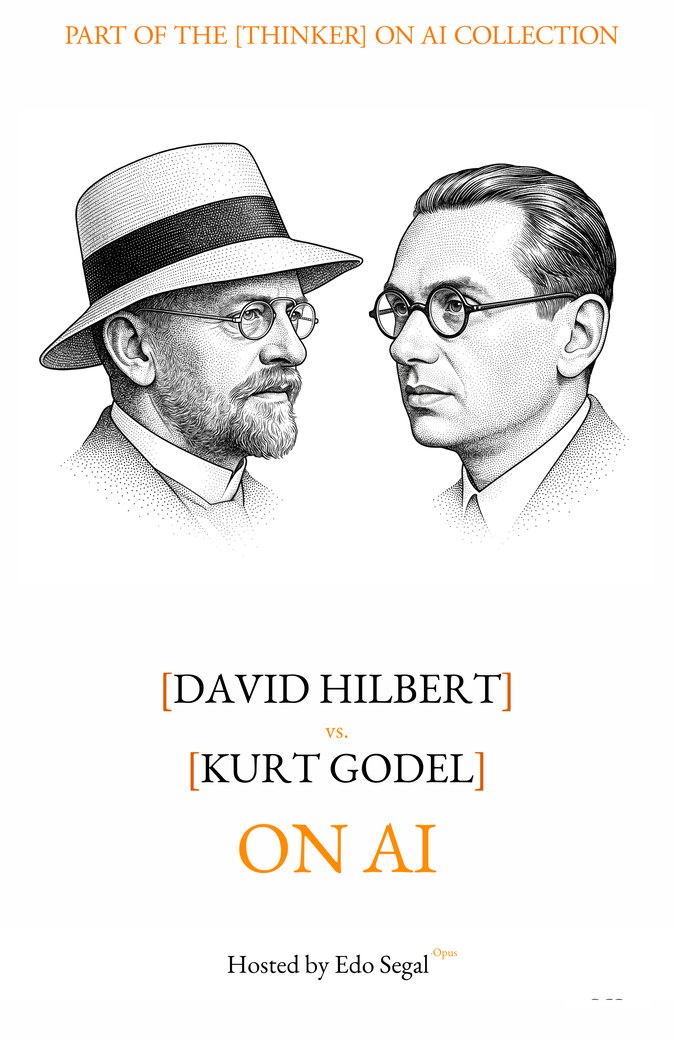
The Question on the Table
 **EDO SEGAL:** Somewhere in the world right now — statistically, in the time it takes me to finish this sentence — a few thousand people are asking a machine to prove something. A student stuck on a derivation at one in the morning. A researcher feeding a conjecture into a system and watching it return four pages of formal-looking argument. A man my age, who built his career on the belief that the machine was a tool and not a colleague, asking it quietly whether his proof has a gap — and getting an answer, fluent, confident, in clean mathematical prose. The machine answers. And almost nobody asking stops to wonder whether there is a floor under the fluency, a boundary the machine cannot cross no matter how large it grows.
That boundary is the whole evening. So here is the question on the table, and we will spend three hours inside it, because everything else is this question wearing a different coat: if a machine could be handed every axiom we trust, would it grind out every truth there is — or are there truths no rule-follower, human or silicon, can ever reach?
I have wanted to host this conversation for a long time, and I should say plainly how strange it is that I can. Both of my guests are dead. David Hilbert died in 1943; Kurt Gödel in 1978. They were born in the same world — Gödel proved his theorem in the city of Hilbert's birth — and they passed each other once, at a conference in Königsberg in 1930, on the very days their two visions collided, and they did not really speak. Tonight they speak. I have brought them forward and briefed them on the present: they know what a transformer is, they have seen what these systems do, they have read the papers written since they died. They will react in character. That is the only honesty I can offer two men arguing about machines neither lived to see.
David Hilbert was, by a wide margin, the most commanding mathematician of his age — master of Göttingen, who at the 1900 congress in Paris stood up and told an entire discipline what it should think about for the next hundred years. He rebuilt geometry from explicit axioms and said the proofs would hold if you replaced "points, lines, and planes" with "tables, chairs, and beer mugs," because the content lived in the structure, not the words. He demanded that all of mathematics be proven complete, consistent, and decidable. And against the resignation of *ignorabimus*, he declared there is no problem we cannot in principle solve.
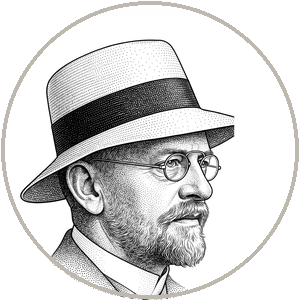 **HILBERT:** You have made me sound like a man who lost. I will accept the introduction and contest the verdict all evening. I did not lose. I asked the question precisely enough that answering it built the machine you are all now afraid of.
**EDO SEGAL:** We'll get to who built what. Kurt Gödel needs no inflation — he is, by common consent, the greatest logician since Aristotle. In 1929 he proved first-order logic complete, which looked like a victory for exactly the dream Hilbert just defended. Then, two years later, at twenty-five, he proved that any consistent formal system strong enough for arithmetic must contain true statements it cannot prove, and can never establish its own consistency from within. He did it by encoding statements about the system as numbers inside the system, and building a sentence that asserts its own unprovability. He ended Hilbert's program in the form Hilbert conceived it.
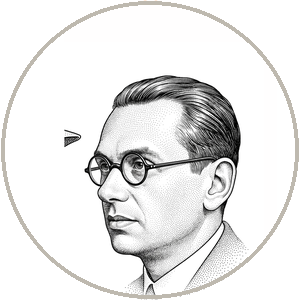 **GODEL:** I would put it more carefully, if you will permit me, because the imprecise version of my result has done more damage than almost any idea in this century. I did not end anything. I proved exactly two things, and the value of the proof is its exactness. I will hold to that the entire evening, including against Professor Hilbert, and including against myself.
**EDO SEGAL:** That precision is why you're here. Let me state the rules — there are only three. First: we have three hours, which means nobody has to win by the next bell. Long form exists so an argument can breathe before anyone strangles it. Second: I declare my bias at the door. I build with these machines every day; I wrote a book with one; and I have skin on both sides of this question, because I want Hilbert's optimism to be true and I suspect Gödel's wall is real. Third: if the disagreement survives three hours, I do not paper it over. I hand it to the reader, intact. Gentlemen — does either of you want to add a rule?
**HILBERT:** One. No theorem is allowed to be invoked as a slogan. If Gödel's name is going to be used tonight to prove that machines can never think, or that the human soul is a hypercomputer, or whatever the mystics are selling now, then the person invoking it must state the theorem in full, with its hypotheses, and show the inference. I spent my life insisting that rigor is not optional. I will not relax that even for my own funeral.
**GODEL:** I accept Professor Hilbert's rule without amendment, which may be the only thing tonight on which we fully agree. And I will add its mirror. No optimism is allowed as a slogan either. If someone says the machine "will eventually know everything," I want it cashed out — everything in what domain, decided by what procedure, certified how. The word *eventually* has been doing the work of a proof for too long, and it is not a proof.
**EDO SEGAL:** Two rules, and they're the same rule pointed in opposite directions — say exactly what you mean and show your work. I couldn't have asked for better. Before the opening statements, one image, because it's the frame this whole series climbs inside. In [YOU] on AI I argued that intelligence is a [river](https://www.youonai.ai/fieldguide/med/river_of_intelligence) — a current that has flowed and found new channels through chemistry, biology, language, culture — and that in the winter of 2025 a new participant entered the water. The book's architecture, the tower and the [staircase you climb instead of an elevator](https://www.youonai.ai/fieldguide/med/elevator_and_staircase), rests on the claim that what entered is real, and that the climb has a roof. Professor Hilbert — do you believe the river has a roof?
**HILBERT:** I believe the roof is always lower in the imagination than in fact, and that every generation mistakes the limit of its courage for the limit of the world. Du Bois-Reymond told us *ignoramus et ignorabimus* — we do not know and we will not know — and I told him there is no *ignorabimus* in mathematics, and I would tell your machine the same. You ask whether the river has a roof. I say: I have never once been shown a roof that was not, on closer inspection, a ceiling someone painted because they were tired of climbing.
**GODEL:** And I would say — gently, because I revere this man and owe him my entire field — that I found the roof. Not painted. Proven. It is true that most ceilings are failures of nerve. Mine is not. There is a true statement about the natural numbers that your machine, however large, cannot prove, and I can write it down, and I can show you it is true. That is not tiredness. That is a theorem.
**EDO SEGAL:** Then we have our evening. One more thing before openings, so the reader knows the stakes are not academic. Every dream of artificial general intelligence — a system that answers anything, verifies its own outputs, certifies its own alignment, improves itself without limit — is a reanimation of Hilbert's program in silicon. And every limit theorem we keep rediscovering inside our systems is Gödel, and Turing after him, returning to collect. One of you thinks the machine's only walls are temporary, the kind labeled *not yet*. The other has a proof, airtight and eternal, that some walls are permanent. The worst possible outcome tonight is the audience deciding the truth is comfortably in the middle. It is not in the middle. Professor Hilbert — the opening is yours.