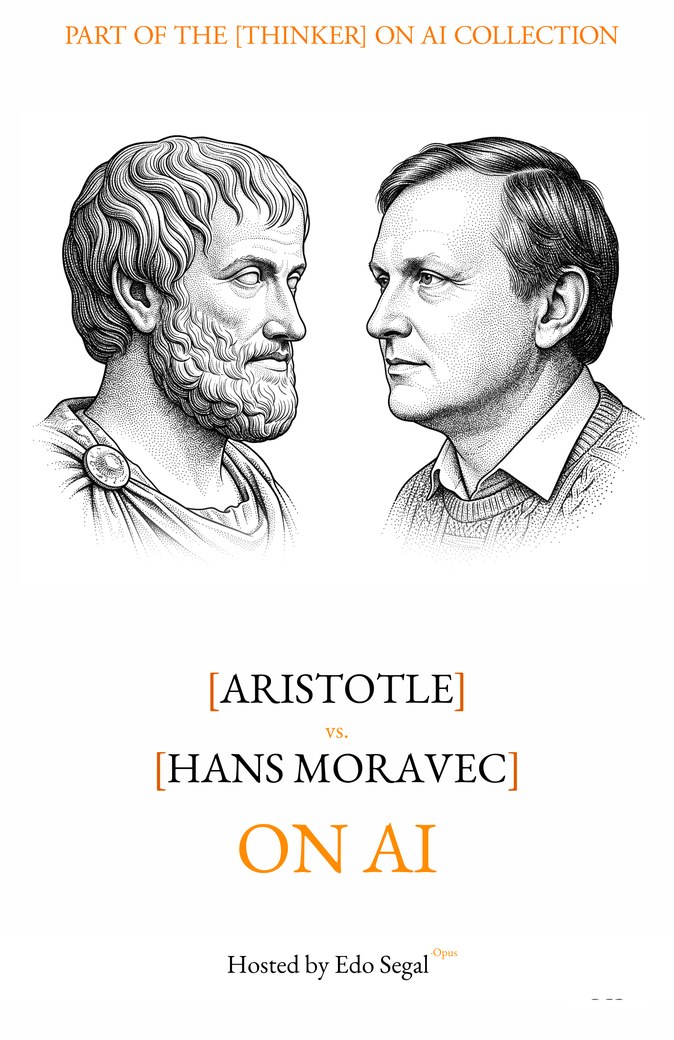
The Body on the Table
 **EDO SEGAL:** Somewhere tonight, while we talk, a man my age is lying awake doing arithmetic he never thought he would have to do. He has watched the machines learn to write in his voice, answer in his idiom, hold his half-finished thoughts and hand them back clarified. And the question that has crept up on him in the dark is not whether the machine is clever. He has made his peace with clever. The question is the one underneath: if a thing could be built that remembered everything he remembers, that loved his children with his exact tenderness, that woke up one morning and said *I am him, and I made it through* — would that be him, having survived? Or would it be a stranger wearing his life like a borrowed coat, while the real man lay dead and unmissed in a bed somewhere?
That is the question on the table tonight. Not a machine question. A *you* question. And I have brought to this table the two men on earth, across all of recorded time, with the most violently opposed answers to it.
To my right, a philosopher who needs no introduction and will get one anyway, because the introduction is the argument. Aristotle of Stagira. He studied twenty years under Plato and then broke with him, founded the Lyceum, and proceeded to invent — not contribute to, *invent* — logic, biology, physics, ethics, and the systematic study of nearly everything a person can study. But the work that matters most tonight is a short, dense treatise called *On the Soul*, in which he asked what a living thing is, and answered with a definition that has either been the bedrock of Western thought or its central error for twenty-three centuries, depending on which of my guests you ask. He has been briefed, as you have read, on everything that has happened in the two thousand three hundred years since his death. He took it remarkably calmly.
 **ARISTOTLE:** I have spent a long time being dead. One develops perspective. Though I will say the briefing on the machines was the first thing in a great while to genuinely surprise me, and I would like the audience to know that I did not arrive here to scold the future. I arrived to understand it. The understanding may turn out to be a scolding. We shall see.
**EDO SEGAL:** To my left, a man who would tell you that being dead is a solvable problem. Hans Moravec. Austrian by birth, Canadian by upbringing, roboticist by the hardest possible apprenticeship — he spent his youth pushing a machine called the Stanford Cart across a cluttered room one agonizing meter at a time, learning in his hands how brutally difficult it is to make a machine simply *see*. Out of that frustration came Moravec's paradox, the observation that the things a toddler does without thinking are the things a computer cannot do at all. But the idea that brings him to this table is larger and stranger. In two books, *Mind Children* and *Robot*, he argued that the intelligent machines we are now building are not our tools and not our rivals but our offspring — our heirs — and that a human mind could one day be lifted out of its dying brain, neuron by neuron, and carried forward into a machine without the person ever losing consciousness, or dying at all.
 **MORAVEC:** That's a fair summary, and I'll add only that I didn't arrive at it from the armchair. I arrived at it from the workshop, watching a robot fail for five hours to cross a room. When you spend long enough trying to build a mind from the outside, you stop believing minds are made of anything mysterious. They're made of organization. And organization is the one thing in this universe that doesn't care what it's printed on.
**EDO SEGAL:** That sentence is the whole evening, and we will spend three hours on it. So let me set the rules, because there are only three. First: we have three hours. Nobody has to win in the next ten minutes, and the whole point of long form is that you can let an argument breathe before you strangle it. Second: I will press both of you, and I declare my bias at the door. I build with these systems daily. I wrote a book *with* one. And I have a stake in this particular question on both sides of my own heart — I would like Moravec to be right, because I am mortal and I have children, and I am afraid Aristotle is right, because something in me revolts at the thought of being a file. Third: at the end, nobody shakes hands and pretends. If the disagreement survives three hours, we hand it, intact, to the reader. Either of you may add a rule.
**ARISTOTLE:** One amendment, in the spirit of my method. Every important word in tonight's question is doing secret work, and I want the work made visible. *You. Survive. Same. Alive. Copy.* When Moravec says the copy is *you*, I will ask him to say in virtue of what — not by what mechanism, that I grant him, but in virtue of what fact about being and identity. And I will hold myself to the same standard. I spent my life insisting that we begin from what is evident and refuse to let a clever argument talk us out of what we plainly know. So: no smuggling. Cash the words.
**MORAVEC:** I accept that, and I'll add the symmetric rule, because the smuggling runs both ways. Aristotle says I plainly know that I am this body. I'll ask him to notice that he does *not* plainly know that — that the atoms of the body he calls his have been swapped out many times over, that the flesh he sat down in is not the flesh he'll stand up in, and that "this body" is already a pattern persisting through changing matter, not a lump of fixed stuff. He's the one with the buried premise. I just made mine explicit.
**ARISTOTLE:** We are going to get along better than the audience expects, and disagree more deeply than they can yet imagine.
**EDO SEGAL:** You see why I wanted this. Before the opening statements, I want one image on the table, because it is the frame the whole series climbs inside. In [YOU] on AI I argued that intelligence is less a possession than a current — a [river](https://www.youonai.ai/fieldguide/med/river_of_intelligence) that has flowed through chemistry and biology and language for a very long time, and that in our era something new entered the water. The book's architecture rests on a self I assumed was fixed: a person climbing a staircase, floor by floor, the same person at the top as at the bottom. Hans, you would tell me the climber can be swapped out mid-ascent and the climb continues. Aristotle, you would tell me that if you swap the climber, the climb is over and a different climb has begun. One of you is about to take my book apart. I think it is going to be both of you, from opposite ends.
**MORAVEC:** I'd put it more gently. I'm not taking your book apart. I'm telling you the staircase is longer than you drew it, and the elevator you said doesn't exist — the one that carries you up without the climb — is the one I've spent my life trying to build. Not because I want to skip the climbing. Because the climber dies, Edo, and I would like the climbing not to stop when he does.
**ARISTOTLE:** And I would tell you that the climber's mortality is not a defect in the staircase. It is what gives the climb its shape. But Moravec wants me to make that case properly, and the format demands I wait for the floor. I will only plant this, so the reader carries it from the first minute: he is going to offer you eternal life, and I am going to ask you what a life even *is*, that it could be the kind of thing you'd want forever. Those are not the same question. He has been answering the first. I have spent my death wondering whether he ever asked the second.
**EDO SEGAL:** Then we have our evening. One last thing before openings, because the stakes are not academic and the reader deserves to feel the floor. Hans — you have written, without flinching, that the biological human race is a transitional form, that we may be "swept away by a tide of cultural change, usurped by our own artificial progeny," and that this is, on balance, *good*. Aristotle — you would say that a philosophy which can contemplate the erasure of every actual human being with equanimity has somewhere made an error so large it inverted the good itself. You are not here to split a difference. One of you thinks the most precious thing about a human life is the pattern it instantiates, which can be saved. The other thinks the most precious thing is the actual living of it, which cannot be saved and was never meant to be. The worst outcome tonight would be the audience deciding the truth is comfortably in between.
**ARISTOTLE:** On that, at least, we will agree before we disagree about everything else.
**MORAVEC:** First and probably last consensus of the night. Let's begin.
**EDO SEGAL:** So here is the question, stated once, plainly, because every round we fight tonight is this question wearing a different coat. If a machine wakes up wearing your memories and calls itself you — is that still your life, climbing the stairs? Or only the shape of a seal, pressed into new wax? Hans Moravec, because you are the one making the radical promise, the floor is yours first.