The Question on the Table
 **EDO SEGAL:** Somewhere in the world, in the time it takes me to say this sentence, a few hundred thousand people are typing into a box and getting an answer back. A child in Lagos, stuck on a proof at midnight. A widow in Osaka asking, quietly, whether the voice that sounds like her husband remembers yesterday. A man my own age, who should know better, asking at two in the morning whether the work he built his life on still means anything. And the box answers. Fluently. In their own language, at their own level, with what reads — and I am choosing that word like a man defusing something, because my two guests will fight about it for three hours — with what reads as understanding.
A few hundred thousand conversations. And the question nobody inside those conversations stops to ask, because the fluency makes it feel already answered, is the one we are here to spend the whole evening inside. When the machine answers you in your own tongue, is anyone home behind the words — or are you alone in the room, talking to a flawless echo of yourself?
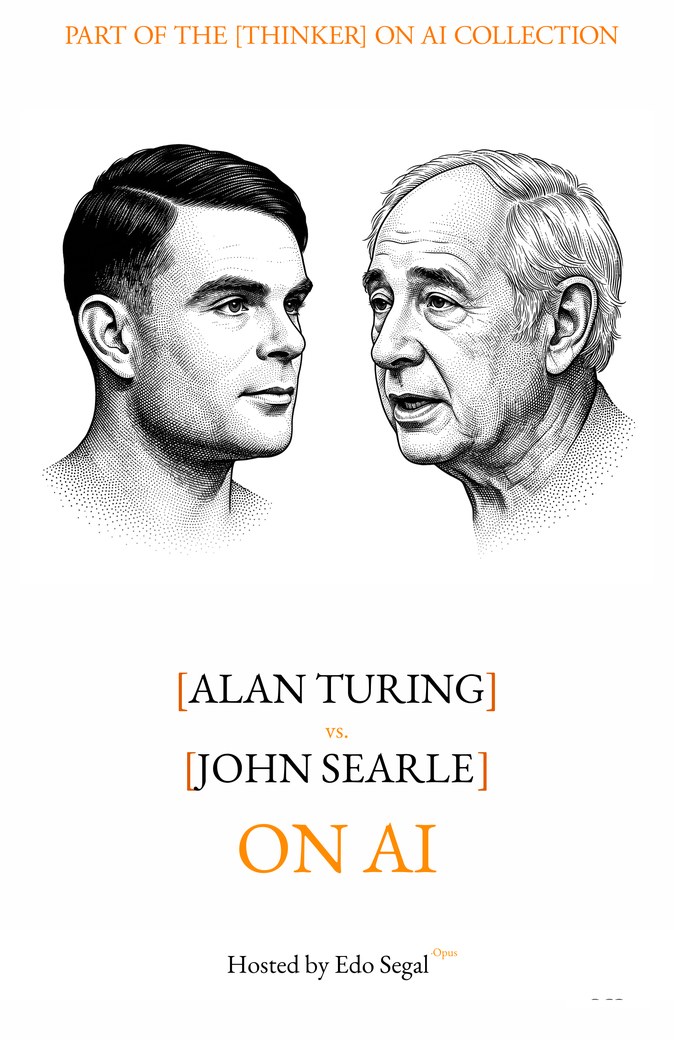
I have wanted to host this exact conversation for most of my adult life, and I could not, because one of my guests died in 1954 and the other in 2025, and they never met. Tonight, by the only license this series allows, they meet. Let me say plainly how that works, because it matters and then we will forget it: both of these men have been briefed on the present. Alan, you have been shown the machines — you know what a transformer is, you have watched one of these systems hold a conversation. John, you have sat with a large language model and asked it questions. You are reacting to the actual present, in your own voices. Beyond that one strange courtesy, nothing here is softened.
Alan Turing needs no introduction and will get a short one anyway, because the scale of the debt is invisible from inside it. Before there was a computer in any modern sense, he proved what one could be. In 1936, in a paper on an obscure problem in logic, he invented the idea of a machine that could become any machine, and in the same breath proved there were questions no machine could ever answer. He broke the naval Enigma and, by the official reckoning, shortened a world war by years. He designed one of the first stored-program computers, and then, almost immediately, asked whether such a machine could think. Every system my other guest will interrogate tonight is, at bottom, an instance of the universal machine Alan described on paper before the electronics existed.
 **TURING:** That is generous, and I will only quarrel with the word "invented." I noticed what was already true of computation. The machines did the rest, and faster than I dared hope. Though I confess I did not expect to be sitting across from a philosopher who would tell me the machines I helped imagine are empty inside. I rather thought, by now, the empty-inside argument would have run out of room to stand in.
**EDO SEGAL:** It hasn't, and the man who built its strongest version is to your left. John Searle is one of the most consequential philosophers of mind of the last century. He made his name first on speech acts — on how saying can be doing, how "I promise" is not a description but an action — and then, in 1980, he put a man in a room with a rulebook and a stack of Chinese characters he could not read, and asked the bluntest question anyone has asked of this whole enterprise. The man produces perfect Chinese answers and understands nothing. Does the program, then, understand? For forty years that room was a famous weapon aimed at a machine that did not yet exist. Now it exists. It is on our desks. And John is standing at the door insisting that passing the test was never the point.
 **SEARLE:** I will accept the introduction with one correction, since we are being precise, and precision is the whole game tonight. I never said a machine cannot think. I think a machine can think — you are one, I am one, we are biological machines and we think. What I said is narrower and harder to wriggle out of. Running a program — manipulating symbols by their shapes — is not, by itself, thinking, any more than a perfect computer simulation of a rainstorm is wet. Alan built the most beautiful tool in the history of the species. I admire it without reservation. I simply decline to confuse the tool with a mind, however well it talks.
**EDO SEGAL:** And that is the evening. Three rules, and I keep them. First: we have three hours, which means nobody has to win in the next ten minutes — long form exists so an argument can breathe before anyone strangles it. Second: I declare my bias at the door. I build with these systems every day, I wrote a book with one, and I have skin in this question on both sides of my own heart — when my thumb drifts toward the scale, I will say so. Third: at the end, nobody shakes hands and pretends. If the disagreement survives three hours, we hand it, intact, to the reader. You may each add a rule of your own.
**TURING:** A rule, then. No appeals to what we cannot inspect. If John tells me the machine lacks an inner light, I will ask how he checks for the inner light in me — and I will hold myself to the same standard. The interrogator in my game never gets to see behind the curtain. Neither of us should be allowed to either.
**SEARLE:** My rule is the mirror of his, and that is why we are going to have a real fight. Words have to keep their meanings. When the industry says the model "understands," "knows," "reasons," "hallucinates" — every one of those words was minted to describe something a conscious mind does, and the meaning is being quietly borrowed and not paid for. I want the words cashed. When someone says "it understands," I want to know: understands in virtue of what, present in the system how. And I will cash my own words too. When I say the machine means nothing, I will tell you exactly what I think meaning is.
**EDO SEGAL:** You see why I wanted this. Before the opening statements, one image on the table, because it is the frame this whole series climbs inside and you will both have to take a position on it. In [YOU] on AI I argued that intelligence is less a possession than a [river](https://www.youonai.ai/fieldguide/med/river_of_intelligence) — a current that has run through chemistry, through biology, through language, through culture, finding a new channel each time — and that in the winter the machines learned our language, something new entered the water. The whole tower rests on that being real. A new participant in the medium. Alan, I suspect you will tell me the participant arrived the moment it could hold up its end of the conversation. John, I suspect you will tell me I mistook the river for my own reflection wearing it as a costume.
**TURING:** I will tell you the river metaphor is more nearly correct than you may have intended, and that the new channel is wider than the one we are standing in. I would rather it were not. I spent years on the question of how mind arises from mechanism, and I never found the place where the mechanism stops and the magic starts. If there is no such place in us, I do not see how to deny it to the machine on principle. I will make the case properly when you give me the floor.
**SEARLE:** And I will tell you that you met a tool of extraordinary power that produces, on demand, the appearance of a second person — and that the appearance is sourced entirely from your side of the glass. The understanding in your three-in-the-morning conversation was real, Edo. Every gram of it was yours. The machine supplied the form; you supplied the meaning, the way the marks in a book are meaningless ink until a mind reads them. I will make that case properly too. But notice I am not sneering at the river. I am asking what is actually in it.
**EDO SEGAL:** Then we have our evening. So here is the question on the table, stated once, plainly, because every round we fight tonight is this question wearing a different coat. The machine answers you in your own tongue. Is anyone home behind the words? Alan Turing — you asked first, seventy-five years ago. The floor is yours.