The Question on the Table
 **EDO SEGAL:** Somewhere tonight — statistically, in the time it takes me to say this sentence — a few hundred thousand people are typing into a box and getting an answer that startles them. A student in Lagos asks for a proof and gets one she did not expect and cannot fault. A composer hums eight bars into a microphone and the machine returns a finished movement in the style of a man dead two hundred years. An engineer, my own age, who should know better, watches the thing write a function he had not thought to write, and feels the floor tilt under a career. And the people who built that box — I have talked to them — increasingly say a strange thing when you press them. They say: we did not design that behavior. We did not predict it. We are not entirely sure how it does it.
That is the whole evening, in one sentence. When the machine surprises the very people who made it — when it does something no one ordered and no one can fully read — is that the machine *originating* something? Or is it only rules running deeper than anyone can follow, surprise mistaken for creation because we cannot see to the bottom of our own work?
I have wanted to host this conversation for a long time, and I could find no two people across the whole span of the subject with more right to it. They are separated by a hundred and eighty years, and they are standing on exactly the same crack in the ground.
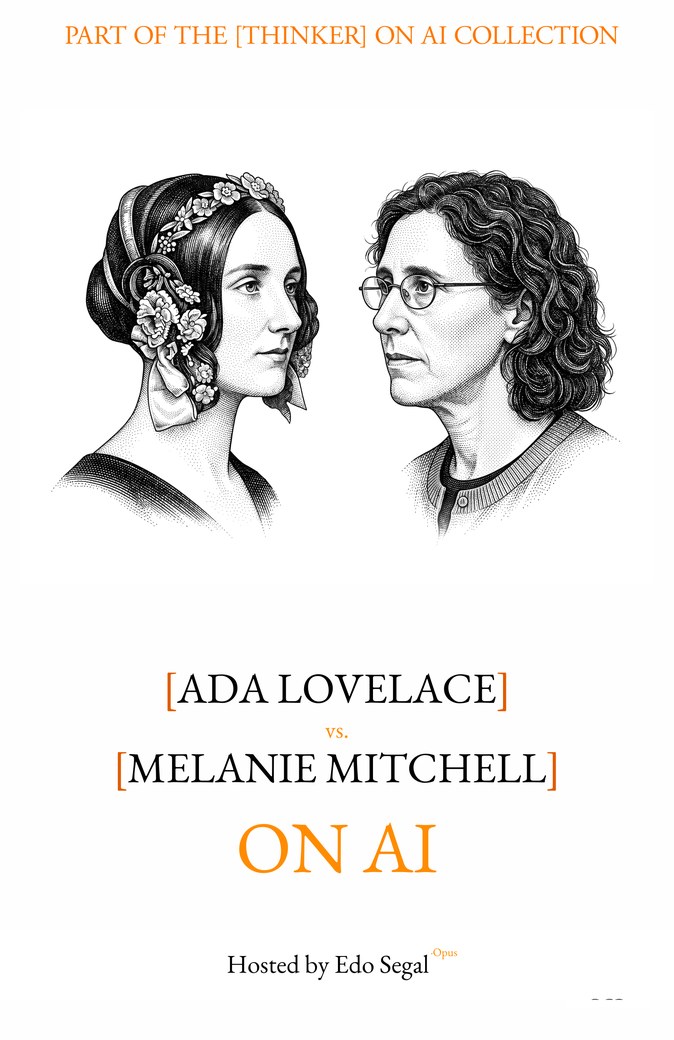
Ada Lovelace wrote the first program and, in the same breath, the first warning. In 1843 she translated an Italian engineer's memoir on Charles Babbage's unbuilt Analytical Engine, appended seven notes of her own that ran three times the length of the original, and in the last and longest of them laid out a method for computing the Bernoulli numbers, step by mechanical step — by most reckonings the first algorithm ever written for a machine. And a few pages earlier she drew the line that founded this entire argument: the engine "has no pretensions whatever to originate anything." She built no machine. She did something rarer. She saw what the machine meant before there was a machine to see.
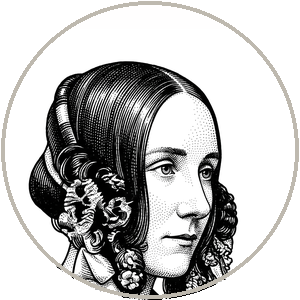 **LOVELACE:** You are generous, and I will accept the introduction with one correction, since the correction is the thing I am here to defend. I did not say the engine was small. I said it was vast — that it might weave patterns of any complexity, that it might compose music, that its reach would exceed anything its designers imagined. And in the same Notes I said it originates nothing. Both are true. If your evening proceeds as though I must surrender one to keep the other, it will proceed past me.
**EDO SEGAL:** Held, and you will see I built the evening to honor exactly that doubleness. Melanie Mitchell needs no anachronism to reach this table. She came to artificial intelligence through Hofstadter's Gödel, Escher, Bach, trained under Hofstadter and John Holland at Michigan, built Copycat — a model of how a mind makes analogies — and then spent decades as the field's most precise auditor: Complexity, the barrier of meaning, the four fallacies, the paper with David Krakauer that mapped the war over whether these systems understand anything at all. She is not a skeptic by temperament. She is a scientist who will not let achievement stand in for comprehension. She is, I think, the clearest voice alive on the gap between what the machine does and what the machine *is*.
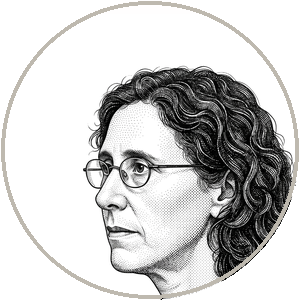 **MITCHELL:** I will take clearest. I will also say, before we start, that I expect to spend a fair amount of tonight agreeing with the Countess about the machine and disagreeing with her about the year. The objection she wrote in 1843 was correct about her engine. Whether it is correct about mine is the only thing worth three hours, and I do not think the answer is the one either of our fan clubs wants.
**EDO SEGAL:** Then we have our evening. Let me set the rules — there are three, and I will hold us both to them. First: we have three hours, which means nobody has to win in the next ten minutes. Long form exists so that an argument can breathe before anyone strangles it. Second: I will press both of you, and I declare my bias at the door. I build with these systems every day. I wrote a book with one. I have skin in this question on both sides of my own heart, and when my stake is touched I will say so out loud rather than let it referee a round in secret. Third: at the end, nobody shakes hands and pretends. If the disagreement survives three hours, we hand it to the reader intact. Either of you may add a rule of your own.
**LOVELACE:** I will add one. The calculation must be checked. I caught an error in Mr. Babbage's working once, and he never forgave the catching and never doubted the value of it. Every claim made at this table about what the machine does — origination, understanding, surprise — I will ask to see worked through, not asserted. A result that cannot be checked is not a result. It is a hope.
**MITCHELL:** I will second that and sharpen it, because it is the discipline of my whole field's better half. The words are where the cheating happens. *Understands. Knows. Learns. Reasons. Originates.* Every one of them carries its full human meaning when we say it of a person and a thin technical shadow when we say it of a machine, and the entire overconfidence of this era lives in the slippage between the two. So when the Countess says "originate," I want it cashed out. And she should make me cash out "understand" before I am allowed to say the machine lacks it. Both directions. No borrowed words.
**EDO SEGAL:** Two rules, both of them about honesty under pressure, and you can already feel the shape of the thing. Before the openings, one image on the table, because it is the frame the whole series climbs inside and you will both have to take a position on it. In [YOU] on AI I argued that intelligence is less a possession than a [river](https://www.youonai.ai/fieldguide/med/river_of_intelligence) — a current that has flowed and found new channels for a very long time, through chemistry, biology, language, culture — and that in the last few winters something new entered the water. The whole architecture of the book — the tower, the [staircase you climb instead of the elevator you ride](https://www.youonai.ai/fieldguide/med/elevator_and_staircase) — rests on the claim that what entered is *real*. A new participant. Ada, I suspect you will tell me there is no new participant at all, only a new and very fine mirror.
**LOVELACE:** I will tell you the river is the right metaphor and you have mistaken what is floating in it. Something new entered the water, yes — an instrument of unprecedented reach. But an instrument is not a participant. The loom that weaves a pattern no weaver imagined has not joined the conversation about beauty. It has only widened the channel through which our conversation flows. I will make the case properly when you give me the floor.
**MITCHELL:** And I will tell you the river is right and the question of what is floating in it is genuinely open, which is the part neither camp can stand. I do not know that the Countess is wrong. I know that "it is only a mirror" and "it is a new mind" are both answers given too quickly, by people applying old words to a thing that may need new ones. My whole objection to this field is that it answers this question by reflex. I would like, for three hours, to not.
**EDO SEGAL:** Then here is the question on the table, stated once, plainly, because every round tonight is this question wearing a different coat. The machine surprises the people who built it. Is that origination — or rules too deep to read? Ada Lovelace, you wrote the objection. The floor is yours.