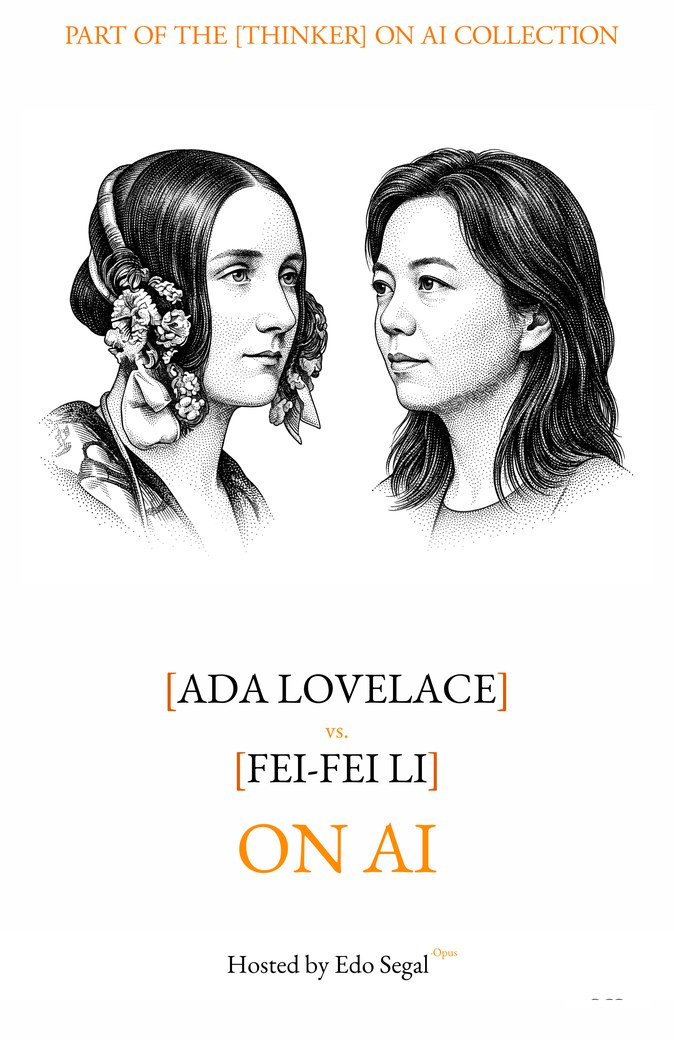
The Question on the Table
 **EDO SEGAL:** Somewhere in the world, in the time it takes me to say this sentence, a machine is about to surprise the person who built it. Not break. Surprise. A researcher will run a model she trained, and it will do something she did not put in — solve a problem in a way she never specified, find a structure in the data she did not know was there. She will lean back from the screen and feel two things at once, and they will not sit easily together: pride, because she made the thing that did it, and a small vertigo, because she could not have done it herself, and she is no longer sure the word *made* is doing honest work.
That moment — that exact flicker between pride and vertigo — is the whole evening. Because the question underneath it is the oldest question we have about machines, and it was asked, in its cleanest form, in 1843, by the first person ever to write a program. When you climb above what you explicitly ordered the machine to do, are you still the author of what it discovers — or has the staircase started building itself?
I have wanted to host this conversation for two years, and I could not, because one of my guests has been dead since 1852. We have arranged an exception. I can think of no two people across the whole history of the field with more right to this table.
Ada Lovelace is the daughter of a poet and a mathematician who chose, against the whole grain of her century, to be the second thing in public and the first thing in secret. In 1843 she translated an Italian engineer's account of Charles Babbage's unbuilt Analytical Engine and appended to it a set of notes more than twice the length of the original — notes that contain what we now recognize as the first computer program, and what I think is the first genuine philosophy of computation. She gave us the loom that weaves algebraical patterns. She also gave us the wall. She has agreed, for tonight, to be told what her loom became.
 **LOVELACE:** I confess I have spent the interval reading, and I am not yet recovered. You built it. You actually built the engine, and then you fed it the whole library, and it began to — well. We shall come to what it began to do. I have opinions.
**EDO SEGAL:** We are counting on them. Fei-Fei Li is a scientist who did something Lovelace would recognize instantly and find unsettling: she declined to program perception, and instead let a machine learn to see by drowning it in examples. She built ImageNet — fifteen million labeled images — and in 2012 a network trained on it, AlexNet, did not so much improve at vision as detonate the field. She is the founding director of Stanford's Human-Centered AI Institute, she has testified before Congress and the United Nations, and she wrote a memoir called *The Worlds I See*. The press calls her the godmother of AI. She would rather you called her an empiricist.
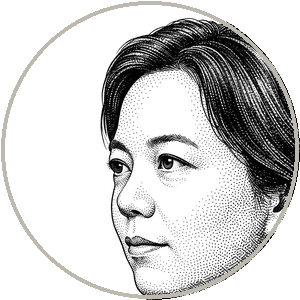 **LI:** I would rather you called me a scientist who is still curious. But I will take the room. And Ada — I have to say this before anything else, because it has been true my whole life — your sentence about the engine having no pretensions to originate is the first thing many of us ever read about machines. Some of us spent our careers trying to find out whether it was still true. I am genuinely not sure what I am going to say to you tonight.
**LOVELACE:** Then we are well matched, because I am genuinely not sure I was right.
**EDO SEGAL:** And that is the format. Let me set the rules of the evening — there are three, and you may each add one. First: we have three hours, which means nobody wins by the next bell. The point of long form is that an argument gets to breathe before anyone strangles it. Second: I declare my bias. I build with these machines every day, I wrote a book with one, and I have felt the vertigo I am about to ask you both to explain — I have watched the staircase build itself under my own feet and then told myself the next morning that I laid every stone. Third: if the disagreement survives three hours, we do not paper over it. We hand it to the reader, intact. Ada, a rule of your own?
**LOVELACE:** Yes. We must distinguish, ruthlessly and at every turn, between what the machine *does* and what we *see* in what it does. The flowers are not in the loom; they are in our perception of the cloth. Half the confusion in your century, I suspect, is people locating in the engine a meaning that lives in their own eye. I want that line drawn freshly every time we cross it.
**EDO SEGAL:** Noted, and it will cost both of you. Fei-Fei?
**LI:** My rule is the mirror of hers, and I think she will accept it. When Ada says the machine cannot originate, I want the claim cashed out empirically — originate in virtue of what, demonstrated how, measured against what. I have spent twenty years watching people declare what machines cannot do, and the machines keep doing it the following spring. So: no claim about the machine's limits that we cannot, in principle, put to a test. [Science, not science fiction](https://www.youonai.ai/fieldguide/med/ai_creativity_debate) — in both directions.
**LOVELACE:** Accepted, and I will hold myself to it. I made my claim about a machine that did not exist. I will not pretend that gives me authority over the ones that do.
**EDO SEGAL:** Then before the opening statements, let me put the image on the table that this whole series climbs inside, because both of you will have to take a position on it whether you like it or not. In [YOU] on AI I argued that intelligence is less a possession than a current — a [river](https://www.youonai.ai/fieldguide/med/river_of_intelligence) that has been finding new channels for a very long time, through chemistry, through life, through language — and that in our recent winter something new entered the water. Ada, you drew a line that says nothing genuinely new can enter through a machine; what comes out was already, implicitly, ordered in. Fei-Fei, your whole career is the claim that structure entered the water that nobody ordered. So let me ask the question on the table, once, plainly, because every round tonight is this question wearing a different coat. When the machine climbs above what we explicitly told it, and finds something — is the finding ours, or has it begun to find on its own? Ada Lovelace, the floor is yours.