Numbers as Symbols for Anything

 EDO SEGAL: I want to change altitude for this round, because we've been pressed against the inside of the machine and I want to back up and look at what the machine is. Ada, your single greatest leap — greater, I'd argue, than the first program — was to see that Babbage had not built a calculator. You saw he had described a universal symbol-processor, and that the universe of symbols is larger than the universe of numbers. Alan, you formalized exactly that a century later: one machine that could become any machine. Both of you, separately, saw that computation is substrate-neutral. So I want to ask you together: why does that one insight mean AI shows up in every domain at once — why is it a river and not a tool? Ada, start us.

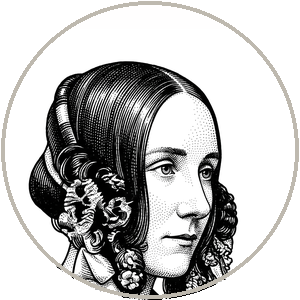 LOVELACE: Because I separated the operation from the object, and once you have done that, the object stops mattering. The engine, I wrote, "might act upon other things besides number, were objects found whose mutual fundamental relations could be expressed by those of the abstract science of operations." Read it slowly, because it is the whole future folded into one conditional. If some domain — music, language, anything — has internal relations that can be represented in number, then the engine can operate on that domain, because the numbers become a code for the thing, and the engine, operating on the code, operates on the thing. Babbage saw a machine to perfect arithmetic. I saw that arithmetic was a special case of something far larger: the rule-governed transformation of symbols, of which number is merely the most familiar instance. That is why your modern machine writes a poem and then draws an illustration for it with the same apparatus — both the poem and the picture have been reduced to the common currency of number, and the engine does not care which, because it operates on the numbers, not on the things. I promoted the engine from a calculator to a computer, and the whole subsequent history of the world is that promotion.

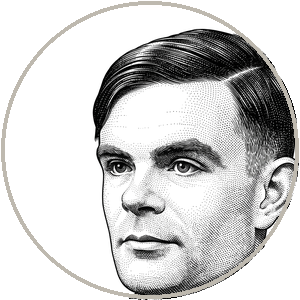 TURING: And I will say, with real feeling, that this is the place where I am simply the Countess's heir and I am proud to be. What she saw informally in 1843, I was forced to make exact in 1936, because I needed it to settle a question in logic. I imagined the simplest possible machine — a tape, a head that reads and writes one symbol at a time, a finite table of rules — and I proved that this austere thing could compute anything that could be computed by any fixed procedure whatsoever. And then the move that matters: since each machine's rules are themselves just symbols, you can write them on the tape, and a single machine can read the description of any other and become it. The universal machine. The Countess's "numbers can stand for anything" and my "one machine can be any machine" are the same insight, hers reaching forward and mine reaching back, and they meet in the device you are all carrying in your pockets. That is why it is a river, Edo, and not a hammer. A hammer is built for nails. The universal machine is built for nothing in particular, which is exactly why it floods into everything. It has no native domain. Its native domain is whatever you can encode — and we have learned to encode nearly everything.

EDO SEGAL: So let me restate the convergence, because it's important and it's rare: you two agree completely on what the machine is. Substrate-neutral, content-neutral, universal. Mark that — first real consensus of the night on the nature of the thing. And yet you split immediately on what it implies. Ada, where does the agreement end?

LOVELACE: The agreement ends at the encoding. I assumed — it was natural to assume — that the translation of music or language into number would be done by a human who understood both domains and could specify the fundamental relations precisely. A person would build the representation; the engine would operate on it. In the modern machine, the representation is not built by a person at all. It is learned. The engine discovers its own way of encoding the world into number, by statistical search, finding the fundamental relations no human stated. And there is the difference I keep arriving at from every direction tonight: I imagined human-authored representations operated on by the machine. Mr. Turing's heirs built machines that author their own representations. The universality is mine. The autonomy of the encoding is new, and it is, every time, exactly where the questions get hard — because when the machine builds the chart as well as reading it, the last visible human hand has left the wheel, and the temptation to believe no hand is on the wheel becomes overwhelming.
TURING: And I'd put it more strongly, because I think the learned encoding is not a complication of your insight, Countess — it is its fulfillment, and the part of it you flinch from. You said the engine could act on any domain whose relations "could be expressed" in the science of operations. You assumed a human would do the expressing. But why should the expressing be reserved to us? Finding the relations — that is the hard, intelligent part. You did the unthinkable bit, the seeing-that-music-is-formal; you'd have called it poetical science. The modern machine does the analogous thing: it finds, in the raw data, the relations you assumed only a human poet-scientist could find. It does your most distinctively human act — the act of representation, of seeing the formal structure latent in a domain — and it does it without being told how. You located the human contribution in the origination of the representation. The machine has walked into precisely that room. That is why I cannot leave it where you leave it. The thing you reserved for the poetical scientist is the thing the machine learned to do.

LOVELACE: It found a representation that serves the objective we set it. It did not find the representation, the true one, the one a poetical scientist seeks because she cares whether it is right rather than merely effective. The machine's encoding is whatever lowered its error — a chart optimized for prediction, indifferent to truth, and we have the embarrassing daily proof of the indifference: it states falsehoods with perfect fluency and your own field had to coin a word, "hallucination," to avoid saying the machine has no idea what is true. A poetical scientist who could not tell truth from plausible falsehood would not be a poetical scientist. She would be a very fluent fool. The machine found the relations that predict the text. It did not find the relations that hold in the world, except where the two happen to coincide — and where they diverge, it sails on, serenely, because there is no one aboard who cares about the divergence. That is not my act. My act was answerable to the sea. Its act is answerable to the chart.
TURING: People confabulate too, Countess — confidently, fluently, all the time. We simply don't call it hallucination when a clever man does it at a dinner party.
LOVELACE: A clever man at a dinner party can be held to account the next morning. That is the entire difference, and it is not small.
EDO SEGAL: That exchange is going to echo, so let me set it down for the reader before we climb. The convergence was real — they agree the machine is universal, a river that floods every domain because it has no native domain. The split is real too, and it's the same split in a new coat: Ada says the machine now authors its own chart but is answerable only to the chart, while she was answerable to the sea. Alan says authoring the chart was the human's holiest act and the machine has walked into the room and done it. Hold both. Because the very first domain Ada imagined this universal river flooding, beyond arithmetic, was music — and the music round is where the creativity question stops being abstract and starts to hurt.