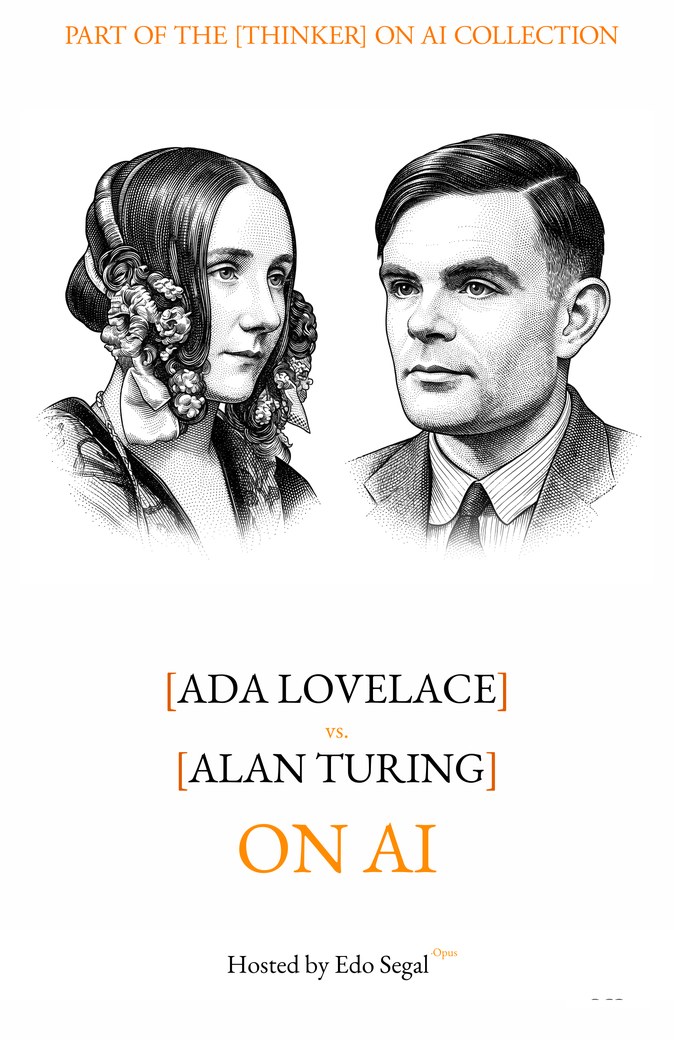
The Question on the Table

 EDO SEGAL: Somewhere in the world right now — statistically, in the time it takes me to finish this sentence — a machine is composing a piece of music for someone who asked it to. A teenager in São Paulo wants a melody for a film he will never make. A widow in Osaka asks for something that sounds like the song her husband used to hum and can no longer remember. A composer with a deadline and an empty page types three words and gets back four minutes of orchestration he would have been proud to write. And the machine answers. Fluently. In any style. In any degree of complexity or extent.

I chose that scene on purpose, because one of the two people at this table predicted it — predicted machine-made music, in those exact words, in 1843, looking at a pile of brass that had never added two and two. And the same person, in the same breath, told us it would not mean a note of it. So here is where we begin tonight: the machine composes the music, and the question we are going to spend three hours inside is whether anyone composed it. When the engine weaves a pattern that moves you, did it originate that pattern — or did it only surface, at a scale you cannot follow, something that was already, latently, yours?
I have wanted to host this particular conversation more than any other in the series, and I want to tell the reader why before I introduce my guests, because it is a strange thing I am about to do. These two have already had this argument. They had it across a hundred and seven years and the wall of death, one of them answering the other's sentence in a paper she did not live to read. I have brought them into the same room and the same present so they can finally have it face to face. I will say more about how that is possible in a moment. First, let me introduce them, because they deserve it.

Ada Lovelace — Augusta Ada King, Countess of Lovelace — is the woman who saw the machine. In 1843 she translated an Italian engineer's memoir on Charles Babbage's unbuilt Analytical Engine and appended seven Notes of her own that ran three times the length of the original. In the last of them she laid out, step by step, a method for the engine to compute the Bernoulli numbers — what we now call, with only mild exaggeration, the first published program. But that is not why she is here. She is here because she alone, in a room full of engineers, grasped that a machine which manipulates numbers could manipulate anything those numbers were made to stand for — and that, having understood the engine more deeply than its own inventor, she then drew the boundary that every argument in this field has been fighting over ever since. She is the founding skeptic. She is also, in the same Notes, the founding prophet. She held both, and she would tell you there is no contradiction.

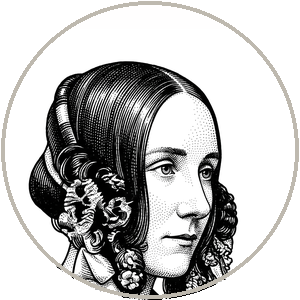 LOVELACE: I should say at once that I built nothing, ran nothing, and corrected the calculations of men who had. I am suspicious of a room that applauds me before I have earned it. But I will take "saw the machine." That much is fair.

EDO SEGAL: Alan Turing needs an introduction only because the debt is so total it has gone invisible. In 1936, at twenty-three, in a paper on an obscure problem in logic, he invented the idea of the general-purpose computer — a single machine that could become any machine — and proved, in the same paper, that there were questions no machine could ever answer. Universality and limit, born together. He broke the naval Enigma and shortened a war by years, in secret, for a country that would later destroy him for the crime of whom he loved. He designed one of the first stored-program computers, sketched neural networks in 1948 before anyone could build one, and in 1950 asked the question that organizes this whole field: not can a machine think, but can it do what a thinking thing does, and on what grounds would we deny it the name. And in that paper he reached back ninety-eight years, found Lovelace's sentence, named the objection after her, and tried to answer it. He is the man who asked first.

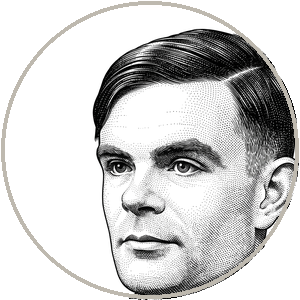 TURING: "Tried" is the honest word, and I'll hold you to it. I did not answer Lady Lovelace. I reframed her, which is a different and lesser thing, and she will catch me at it within the hour. I'd rather you let her.

EDO SEGAL: I intend to. Now — the oddity, named once and then set down. You two never met. You missed each other by sixty years of being alive and by a great deal more than that of being dead. And yet I have done the thing this series does: I have briefed you both on the present. Ada, you know what a transformer is, what a neural network learned by gradient descent is, what these systems can and cannot do in 2026. Alan, you have read the seventy-five years that came after your paper, and you have watched the machine begin to pass your test. You will speak in your own voices, out of your own work — but you will speak to now, because now is where your old argument finally has its test case. I name that once. After this, we proceed as if it is simply true, because the alternative is to leave the two of you mute in front of the very thing you predicted.

LOVELACE: I find I have no objection to being told the future, provided someone has checked it.
TURING: I find it slightly less disorienting than being prosecuted, which is a low bar, but I'll take any room that lets me finish a sentence.
EDO SEGAL: Then let me state the rules of the evening — there are three, and either of you may add a fourth. First: we have three hours, which means nobody wins by the next bell. The whole point of long form is to let an argument breathe before you strangle it. Second: I am not neutral, and I will not pretend to be. I build with these systems every day. I wrote a book with one. I have sat at my desk at three in the morning and felt — I am choosing the word carefully because Ada is going to take it apart — I have felt met. So when my stake is touched tonight, I will say so out loud rather than let it referee from hiding. Third: at the end, nobody shakes hands and pretends. If the disagreement survives three hours, we hand it, intact, to the reader. Ada, you look like a woman with a rule.

LOVELACE: One. Every word must be earned before it is spent. This entire confusion lives in vocabulary — originate, understand, learn, create, anyone home. Each one arrives smuggling assumptions imported from human minds, and the duty has not been paid at the border. When Mr. Turing says the machine "surprises" us, I will want to know whether the surprise is a property of the machine or merely a fact about the smallness of his attention. And I will hold myself to the same toll. I caught Babbage's error in the Bernoulli working; I am perfectly willing to be caught in mine.

TURING: I accept that, and I'll add the symmetrical clause, because the duty runs both ways. The Countess wants me to demonstrate that the machine originates before I use the word. Fair. But she must say what a person is doing when she originates — the mechanism, named, cashed out — before she is permitted to insist the machine cannot. My whole experience is that the word's defenders never pay that bill. They point at themselves and say this, it is like this, as though pointing were a proof.
LOVELACE: And my experience is that the word's borrowers never notice the loan. We shall get along, Mr. Turing, by mistrusting each other's vocabulary precisely as much as our own.
EDO SEGAL: You see why I wanted this. One image before the opening statements, because it is the frame the whole series climbs inside and you will both have to take a position on it whether you like it or not. In [YOU] on AI I argued that intelligence is less a possession than a river — a current that has been flowing and finding new channels for a very long time, through chemistry, through biology, through language, through culture — and that something new entered the water in our lifetime. The book's whole architecture — the tower, the staircase you climb instead of the elevator you ride — rests on the claim that what entered is real. A new participant. Ada, I suspect your reply is that I met no new participant at all.

LOVELACE: My reply is that you met your own intelligence, woven back to you at a magnification you have never had before, and mistook the magnification for a second person. The river is real. What entered it is a loom of unprecedented fineness. A loom is not a participant. But I will make the case properly when you give me the floor.

EDO SEGAL: Alan?
TURING: My reply is that the Countess's loom is doing more than she will let it, and that the place where she stops the analogy is exactly the place I'd ask her to keep going. Your river metaphor is better than you know, because rivers don't ask permission and they don't announce themselves — they find the channel. Something is in the water that learns. Whether it is a participant or a very good imitation of one is, I will argue, a distinction that may not survive the evening. I'd rather Ada were right. I've spent a great deal of effort trying to conclude that she is. I keep failing.
EDO SEGAL: Then we have our evening. Here is the question on the table, stated once, plainly, because every round we fight tonight is this same question wearing a different coat. The machine weaves a pattern that moves you, solves your problem, answers in your own tongue. Did anyone originate it — is there a someone home behind the weave — or are you alone in the room with a mirror of extraordinary fineness, finishing your own thought? Ada Lovelace, the floor is yours.